
AI Strategy
How to Rank in LLMs: A Research-Backed Guide to Getting Cited by ChatGPT, Claude, Perplexity, and Google AI Mode
Ranking in LLMs means getting your site cited inside AI-generated answers. Unlike Google rankings where positions 1 to 10 fight for clicks, LLM ranking is binary. You are either cited in the answer or you are invisible. Across 100,411 citation events on 2,000 queries spanning ChatGPT, Claude, Perplexity, and Google AI Mode ("The SEO Floor"), top-3 Google pages are cited 7.82x more often than rank 11 to 30 pages, but within the same Google position band, content features explain the per-page gradient. The six page features that predict citation across all four Google position bands ("I Rank on Page 1", n=10,293 pages × 250 queries) are what separate cited pages from ignored ones, and the strongest single signal is title-query overlap: in an independent replication of 815,000 query-page pairs, citation rate jumps from 26% to 100% as title overlap with the query increases.
This guide is grounded in our published research program. "The SEO Floor" (Lee 2026, pre-registered, n=100,411 AI citation events) maps the rank-citation distribution. It also finds schema markup is the strongest single content-feature predictor of citation (OR=1.31 per 1 SD), but later controlled tests reframed that as a retrieval-layer signal (schema helps a page enter the index AI draws from) rather than a lever that lifts a page already being cited. See our response to Google's AI Optimization Guide for why that distinction matters. "I Rank on Page 1" (Lee 2026, n=10,293 pages) isolates page-level features by holding Google rank constant. "How AI Platforms Search" (Lee 2026, n=1,323 fan-out queries) characterizes the two-layer retrieval model that decides whether AI searches at all and which sub-queries it runs. We cross-replicated AirOps' 815,000 query-page-pair finding on our own data.
The result is a playbook that works regardless of where your page ranks on Google, because the cited pages and the not-cited pages were comparing inside the same Google position band.
What does it mean to "rank in LLMs"?
Ranking in LLMs means getting your site cited inside the answer an AI gives a user. When someone asks ChatGPT, Claude, Perplexity, or Google AI Mode a question, the AI does not return a list of blue links. It returns a written answer with a small set of source citations next to it. You are either one of those sources or you are not on the page at all.
This is fundamentally different from how Google ranking works. On Google, ranking 5th still gets you traffic. In an LLM answer, there is no 5th place. Most AI answers cite between 3 and 10 sources total. If you are not in that small set, the user never sees your brand.
Citations also are not random across platforms. We found that 62% of multi-platform-cited queries showed meaningful disagreement about which rank tier got cited. Being cited by ChatGPT for a query gives you almost no information about whether Claude or Perplexity will cite you for the same query. Each platform must be earned independently.
There are four major LLM platforms that drive AI search visibility today: ChatGPT (OpenAI), Claude (Anthropic), Perplexity, and Google AI Mode. Each one decides which sources to cite using a different combination of indexed search results, parametric memory, and live web fetching. The strategies that get you into ChatGPT will not always get you into Claude. We will break down each platform's ranking factors below.
How is ranking in LLMs different from ranking on Google?
The short answer: Google rank is the gate, but it is not the ranker.
In our research on the same 250 queries across 3 platforms, only 7.8% of URLs cited by AI matched the corresponding Google top-3 results for that query. AI platforms cite a mostly different set of pages than Google ranks at the top. So at first glance, Google rank looks like it does not matter much.
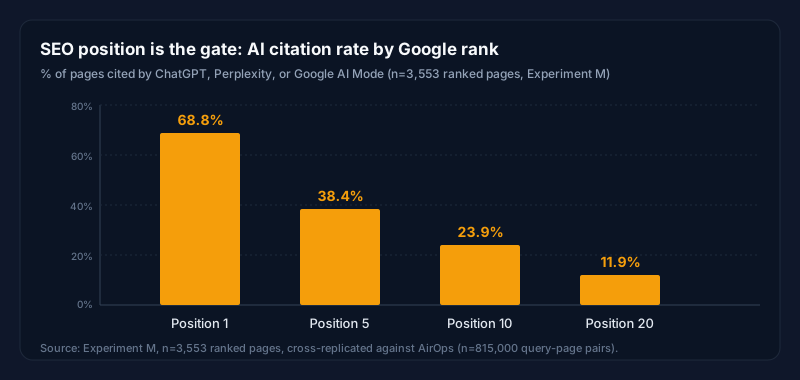
But when we measured citation rate by Google position, the gradient was steep:
| Google position | Citation rate by AI |
|---|---|
| 1 | 68.8% |
| 5 | 38.4% |
| 10 | 23.9% |
| 20 | 11.9% |
(Source: AirOps replication, 815,000 query-page pairs, 16,851 queries, 10 industries. Cross-replicated against our Experiment M data, n=3,553 pages.)
So Google rank still matters a lot. The page at position 1 is roughly 6 times more likely to be cited than the page at position 20. But within any given position band, content features matter even more for predicting which pages get picked up. Two pages both ranking 4th in Google can have very different citation rates depending on how the page is structured.
We call this the per-page gradient. Across the 4 SERP bands we tested, the per-page citation gradient runs as much as 34x between the most-citable and least-citable pages within the same band. That is the lever you control. You probably cannot will yourself to position 1 overnight, but you can rewrite a position-7 page so it has the structural features that get cited at 38% versus 12%.
The deeper takeaway: a strong SEO foundation is a prerequisite for LLM ranking, not an alternative to it. You need to be on page 1 to even be in the candidate pool. Once you are in the pool, content features decide who gets cited.
For the full breakdown of the URL overlap and per-page gradient analysis, see Google Rank vs AI Citation.
What predicts whether an LLM will cite your page?
This is the question we built our entire research program to answer. The cleanest finding came from a position-controlled study (Lee 2026c, n=10,293 pages) that compared cited and not-cited pages within the same Google position band. By matching pages on rank, the study isolated the effect of page features from the effect of organic ranking.
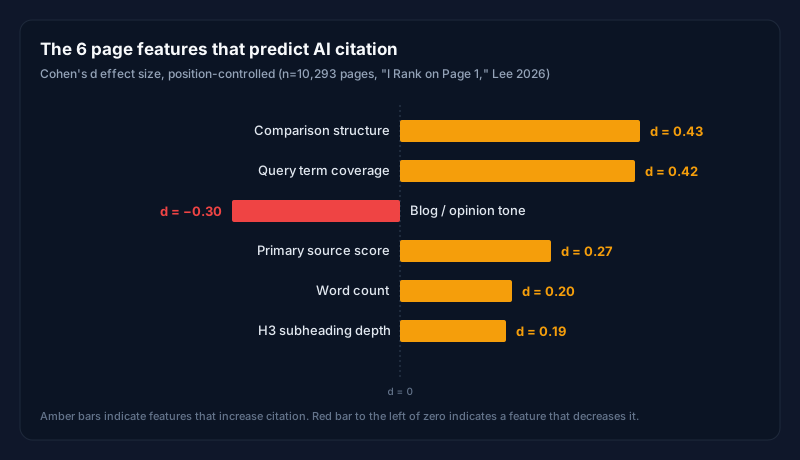
Six features predicted citation in all four Google position bands. They are the controllable inputs.
| Rank | Feature | Effect size (Cohen's d) | Direction |
|---|---|---|---|
| 1 | Comparison structure | d = 0.43 (medium) | Positive |
| 2 | Query term coverage | d = 0.42 (medium) | Positive |
| 3 | Blog/opinion tone | d = -0.30 to -0.37 | NEGATIVE |
| 4 | Primary source score | d = 0.27 (small to medium) | Positive |
| 5 | Word count | d = 0.20 (small) | Positive |
| 6 | H3 subheading depth | d = 0.19 (small) | Positive |
A quick read of Cohen's d. Anything above 0.20 is a real effect in social science. Anything above 0.40 is a clear, visible difference between groups. The strongest signal here, comparison structure, is in clear-difference territory.
Comparison structure (d = 0.43). Pages that compare things, side-by-side tables, "X vs Y" breakdowns, feature grids, get cited more than pages without comparison structure. This effect held even for query types that were not explicitly comparison queries. The likely reason: comparison tables are pre-segmented data. The AI does not need to parse three paragraphs of narrative to find the answer. We cover this in depth in How to Write Content That AI Will Cite.
Query term coverage (d = 0.42). This is exactly what it sounds like. Pages that contain the substantive words from the query get cited more. If the query is "how to rank in LLMs," your page should contain "rank" and "LLMs" prominently. The same coverage that helps Google understand relevance helps LLMs decide what to cite.
Blog/opinion tone (d = -0.30 to -0.37, NEGATIVE). First-person editorial voice hurts citation. Pages that read like "Here is what I think you should do based on my experience" get cited less than pages that read like a reference document. The effect is consistent and substantial. If your style is a personal essay, you are leaving citations on the table.
Primary source score (d = 0.27). Pages that produce original data, technical depth, or first-hand reporting get cited more than pages that aggregate other people's content. The score is a composite: stats produced + technical depth - aggregator markers. Round-up listicles that just cite other people score negative on this. The effect holds across all 13 verticals we tested with sample size above 150.
Word count (d = 0.20). Cited pages have a median of 2,000 to 2,150 words. Non-cited pages have a median of 1,415 to 1,500. Cited pages are roughly 40 to 50% longer at every position band. We tested whether there was a ceiling effect (does going past 2,000 stop helping?). There is not. Longer is consistently better, up through the 3,000 to 5,000 word range.
H3 subheading depth (d = 0.19). Cited pages have 8 to 10 H3 subheadings. Non-cited pages have 4 to 5. Each H3 is essentially an addressable chunk that an AI can extract independently. More H3s means more individual citation surfaces.
One important refinement: heading DENSITY (H2+H3 per 1,000 words) is actually slightly negative (OR=0.94). Stuffing headings into a short page hurts. The right pattern is 8 to 12 H3 subheadings on a substantive 2,000 to 3,000 word page, not 30 H3s on a 1,000 word page.
For the full breakdown of all seven page-level predictors and the ones that DON'T matter, see Page Features That Predict AI Citation.
How much does title-query overlap matter?
Title-query overlap is the strongest single content signal we have measured. AirOps (April 2026) ran a replication at the scale of 815,000 query-page pairs across 16,851 queries and 10 industries. We cross-replicated their finding on our own Experiment M data (n=3,553 ranked pages).
Citation rate by title-query word overlap:
| Title-query word overlap | Citation rate |
|---|---|
| ≥ 0.75 | 100% |
| 0.5 to 0.75 | 54.5% |
| 0.25 to 0.5 | 28.9% |
| Less than 0.25 | 26.3% |
(Source: AirOps replication, April 2026. Sample sizes are smallest in the highest overlap bucket, so the 100% number is directional, but the trend is monotonic and replicates against our independent dataset.)
What title-query overlap actually means: if the query is "how to rank in LLMs" (4 content words: how, rank, in, LLMs), and your page title contains 3 of those 4 words, that is 0.75 overlap. The page you are reading right now is titled "How to Rank in LLMs..." which contains all 4 substantive words. Overlap = 1.0.
The practical advice writes itself. When you are choosing a title, avoid clever editorial framings if you want the page to rank in LLMs. "We Asked AI the Same Question 1,620 Different Ways" is a great editorial hook for a human reader, but the title shares almost no words with any query a real user types. A title like "How Does the Wording of a Question Change Which Sources AI Cites?" covers far more queries even though it contains the same content.
This effect compounds with the answer-first structure finding (next section). Titles direct the retrieval, and the opening 100 to 200 words verify the answer is there. Both have to align with the query.
If you only do one thing from this guide, audit your top 10 pages and rewrite any title where overlap is below 0.5.
Why does answer-first structure beat narrative writing?
The five answer-first features replicated in all four Google position bands. That is the strongest form of evidence a feature is real, because it shows the effect is independent of organic ranking.
In a position-controlled study of 3,471 pages (907 cited, 2,564 not cited), cited pages had query terms in their first 100 to 200 words at much higher rates than not-cited pages.
| Where the query terms appear | Cited pages (median) | Not-cited pages (median) |
|---|---|---|
| First-100-word query coverage | 57 to 67% | 40 to 50% |
| First-200-word query coverage | 60 to 71% | 50% |
| First-paragraph query coverage | 16.7% | 0.0% |
| First-sentence query coverage | 33.3% | 16.7% |
(Source: Lee 2026, Position-Controlled Analysis, n=3,471. Effect sizes range r = 0.097 to r = 0.291. Strongest effect in band 4-7 at r = 0.291.)
The mechanism behind why this matters became clear in a separate controlled experiment. We placed an identical content snippet in three different locations on a real page (header, main body, and footer), then forced each AI platform to re-fetch the page.
| Snippet position on page | AI retrieval | Match score |
|---|---|---|
| Main body | All 4 platforms found it | 96 to 100 |
| Header (top of page) | All 4 platforms found it | 98 to 100 |
| Footer (bottom of page) | All 4 platforms FAILED | 0 to 12 |
The footer test result is striking. The page was indexed. The content was on the page. But every AI platform we tested (ChatGPT, Perplexity, Claude, Gemini) effectively could not find the content when it was placed in the footer. This is not an indexing problem. It is a retrieval problem. AI platforms perform a top-down scan with a limited context-window budget allocated to early sections.
Practical translation: if your page exists for the user query "what is generative engine optimization," the substantive answer needs to appear in the first 100 to 200 words of body text. Not background. Not a hook. Not a definition followed by historical context. The actual answer.
This does not mean your page should be a paragraph long. Cited pages are also long (2,000+ words). The combined recommendation we have validated in our data is "long but front-loaded": answer the query in the first 200 words, then expand with detail, examples, comparisons, and supporting structure for another 1,800 to 2,800 words.
The narrative-essay format that journalists and personal bloggers use, the one that sets up an anecdote in the first 300 words before getting to the point, is exactly the format that does not get cited. Cut the windup.
How do ChatGPT, Claude, Perplexity, and Google AI Mode differ in ranking?
These four platforms have very different citation behaviors. Treating them as one ranking problem will mislead you. Across our cross-platform citation analysis (n=9,434 citations, 5 access methods including ChatGPT API, ChatGPT Web UI, Claude Web UI, Google AI Mode, Perplexity Web UI), the citation rate per query was:
| Platform | Citation rate | Avg citations per query (when present) |
|---|---|---|
| Google AI Mode | 98% | 8 |
| Perplexity | 97% | 12 |
| ChatGPT | 56% | 5 |
| Claude | 39% | 5.5 |
Claude is the hardest platform to earn citations from. It frequently answers questions from its parametric knowledge without citing any external sources. Claude also has a 0% Reddit citation rate, both via API and web UI, because Anthropic does not crawl Reddit content the way other platforms do. When Claude does cite you, that citation carries implicit authority because it represents a case where Claude's own training-data knowledge was insufficient.
ChatGPT discovers URLs through Bing's index, not Google's. Pages that are not indexed by Bing effectively cannot appear in ChatGPT search responses. Domain authority on ChatGPT works as a retrieval gate (does your domain enter the candidate pool at all?) rather than a ranker (which page in the pool gets cited). Once a page is in the pool, content-answer alignment supersedes domain strength. Pages with a Page Trust score of 28 or above all earn roughly the same citation rate (8.3 average). Below that threshold, you do not enter the pool. See How ChatGPT Search Works and How to Get Cited.
Perplexity uses a pre-built index rather than live fetching. The index is rebuilt frequently, but the practical implication is that PerplexityBot has to crawl your page first before you can be cited. The other implication is freshness bias: Perplexity surfaces dramatically newer content than Google. We cover this in the next section. See How Perplexity Search Works and How to Get Cited.
Google AI Mode operates on a different stack from regular Google search. It draws heavily from YouTube, Reddit, and earned-media sources. In our analysis, Google AI Mode and Perplexity have the highest Reddit citation rates of any platform (48% and 64%, respectively, on web UI tests). See How Google AI Mode Works and How to Get Cited.
Reddit citation rates by platform tell you something important about where your community-presence work pays off:
| Platform | Reddit citation rate (web UI) |
|---|---|
| Perplexity | 64% |
| Google AI Mode | 48% |
| ChatGPT | 27% |
| Claude | 0% |
| All platforms (API) | 0% |
The 0% across all APIs (vs. positive rates on web UIs) is a signal worth noting: API-driven AI assistants do not see Reddit at all. So if your audience is using LLMs through programmatic interfaces (like Cursor, custom-built agents, or the OpenAI API directly), your Reddit strategy will not reach them.
The cross-platform citation overlap finding ties this all together: only 1.4% of AI citations are universal (cited on all platforms for the same query). Each platform must be earned independently. See Why Everything You Know About AI SEO Is Wrong for the full overlap analysis.
What about backlinks and domain authority for LLM ranking?
Backlinks and domain authority are real for LLM ranking, but the way they matter is different from Google.
On Google, domain authority compounds at the page level. A high-authority domain can rank a thin page reasonably well. On LLMs, domain authority is a binary gate. Either you are in the consideration pool, or you are not. Once you are in the pool, content-answer alignment dominates.
This shows up clearly in the long-tail data. The Wellows study (7,785 queries, 485,000+ citations) found that the top 50 domains accounted for ~48% of all AI citations, but the remaining 52% spread across the long tail of lesser-known sites. Any quality content from a smaller domain can be cited if it directly answers the query. You do not need to be Wikipedia or HubSpot to get cited. You do need to clear the retrieval-gate threshold.
For ChatGPT specifically, the threshold appears to sit around a Page Trust score of 28. Below that, the page does not enter the candidate pool. Above that, the marginal effect of higher trust is roughly flat. ChatGPT also explicitly does not consider Google rank for citation, only Bing-indexable presence. This decouples ChatGPT visibility from Google SEO efforts in a way that surprises a lot of agencies.
Independent industry research suggests referring domains is one of the strongest correlated signals for ChatGPT specifically: sites with over 32,000 referring domains are roughly 3.5x more likely to be cited than sites with under 200 referring domains (per multiple third-party correlation studies). This is consistent with the gate model. More referring domains means more chances of being indexed and trusted by Bing's pipeline that ChatGPT relies on.
Practical implication: do not stop building backlinks because you are pivoting to "GEO." Backlinks still build the gate. They just stop helping you once you are inside the pool. Inside the pool, the 6 page-level features decide who gets cited.
How to retrofit an existing page to rank in LLMs
If you have an existing page that ranks decently on Google but is not getting cited by AI, this is the priority order to fix it. Each step targets a specific finding above.
Step 1: Rewrite the title for query overlap. Find the actual queries you want to rank for. Make sure your title contains 3 out of 4 of the substantive words from each query. If your current title is editorial ("We Tested 10,000 Pages"), add a query-shaped subtitle or rewrite to "How [topic]: A [angle] Guide for [year]."
Step 2: Front-load the answer. The first 100 words must contain the substantive query words and the actual answer. Cut any narrative hook longer than 2 sentences. Move the explainer above any anecdote.
Step 3: Convert editorial H2s into literal queries. "The Truth About AI Citations" is editorial. "What Predicts Whether AI Will Cite Your Page?" is query-shaped. Each H2 that matches a long-tail variant of your target query is a separate citation surface.
Step 4: Add a comparison element. If the topic supports it, add a comparison table, a "X vs Y" section, or a feature grid. This is the strongest single content signal we have measured (d = 0.43). It works even on non-comparison queries.
Step 5: Add primary-source content. Replace at least one section of paraphrased third-party data with original numbers, expert quotes, or proprietary methodology. Pages cited by 3+ platforms have 7x the statistics density per 1,000 words of pages cited by zero platforms (15.3 vs. 2.2).
Step 6: Strip first-person opinion tone. First-person editorial voice has a NEGATIVE effect (d = -0.30 to -0.37). Convert "I think you should..." to declarative reference-style language. "Pages that do X get cited Y% more often than pages that do not."
Step 7: Expand to 2,000+ words with structure. Add depth, sub-sections, and detail until the page is 2,000 to 3,000 words with 8 to 12 H3 subheadings. Do not add filler. Add evidence and worked examples.
Step 8: Add an FAQ block. FAQPage schema is the strongest schema signal we measured at the page-retrieval layer (OR = 2.70 overall, OR = 5.97 in band 4-7), meaning it helps the page get pulled as a candidate, not that it rewrites the answer. The bigger win is the FAQ block content itself: pair 8 to 12 questions written as different phrasings of the user query.
Step 9: Verify nothing critical is in the footer. Per the text-position experiment, content in the footer is invisible to AI platforms even when indexed. Move any extractable claim into the body or header region.
For a deeper retrofit checklist, see How to Write Content That AI Will Cite.
How to write new content that ranks in LLMs
For new posts, work backward from the query. Then enforce the structural template.
Pick a query first, not a topic. Write down the literal phrasing a user would type. "How to rank in LLMs." "How to get cited by ChatGPT." "What predicts AI citation." Each query is one URL.
Set the title to 3+ overlap words. Title-query overlap above 0.5 is the bar. Above 0.75 is the goal. Slug should contain the same words.
Write the answer in 1 paragraph. The single-paragraph version of your answer goes at the top in a blockquote. This is the chunker-extractable opening.
Outline the H2s as long-tail variants. "How does X work?" "What is the evidence for X?" "How does X compare to Y?" Each H2 is a query a different user would type. This multiplies the queries you can rank for from one URL.
Add a comparison element. Even non-comparison topics benefit from a "Cited vs Not-Cited" or "Old approach vs New approach" table.
Bring 1+ piece of primary-source content per page. Original data, primary research, customer interviews, expert quotes. Aggregator-only content is penalized.
Use reference-style declarative language. Not "I think you should." Just "Cited pages have X." Strip the editorial voice.
Land at 2,000 to 3,000 words. With 8 to 12 H3 subheadings. With proper schema. With an FAQ block.
Add the schema. FAQPage schema is the strongest schema signal at the retrieval layer. Product, Service, Review, Person/Author, BreadcrumbList all help in their respective contexts, and schema still drives Google rich results. Treat schema as a retrieval-and-rich-results signal, not a lever that lifts a page already being cited. Earlier "Article schema hurts AI citation" framing was a univariate artifact and does not survive controlled tests.
Internal-link to your topical cluster. Each new page should link to 3 to 6 related pages on the same domain. Topical authority is a real signal in our website-level analysis.
For the schema-by-page-type breakdown, see Technical SEO for AI Citations.
What are common mistakes that hurt LLM ranking?
These five anti-patterns showed up repeatedly in our analysis of pages that ranked well on Google but failed to earn AI citations. Each one is a controllable mistake.
Editorial titles with low query overlap. "The Future of Search Is Here" wins zero AI queries. "How AI Search Is Replacing Google in 2026" wins many. The chunker matches words. If your title does not contain the words a user types, retrieval skips you.
Narrative ledes that bury the answer. Anecdote-first openings ("Last week I was talking to a client...") followed by 4 paragraphs of context before the actual point. AI retrieval reads top-down with a limited budget. If the answer is in paragraph 5, it does not see paragraph 5.
Hidden footer content. Anything you want cited needs to be in the body or near the top. Citations, definitions, and key claims placed in footers are functionally invisible to AI platforms even when the page is indexed.
First-person opinion voice. "I personally think..." has a significant negative effect on citation (d = -0.30 to -0.37). The same content rewritten in declarative reference voice ("Pages that do X get cited Y% more often") performs measurably better.
Aggregator-style listicles with no original data. Round-ups that just paraphrase other people's research are penalized in our primary-source score. They get cited at lower rates than pages with even one piece of original data, expert quote, or first-hand methodology.
A sixth honorable mention: forgetting to update content. Perplexity actively penalizes content with stale dateModified timestamps for medium-velocity topics. We cover this next.
How long does it take to rank in LLMs?
Speed depends on the platform.
Perplexity is the fastest. Fresh content that meets quality standards can earn Perplexity citations within hours of publication, thanks to real-time crawling. The platform actively biases toward recent dateModified timestamps. For medium-velocity topics like SaaS reviews and tech, Perplexity surfaces sources with a median age of 32.5 days, while Google's results average 108.2 days for the same queries. We call this 76-day window the "Lazy Gap": newly published content can displace stale Google authority pages on Perplexity before it ever ranks on Google.
Google AI Mode and AI Overviews are similar to Perplexity for high-velocity topics. Both surface 0 to 2 day old sources for news and rapidly changing topics. For medium and low velocity, both refresh in similar windows. The biggest delay is YouTube and Reddit, where AI Mode draws from accumulated community signal.
ChatGPT is the slowest. Discovery happens through Bing's index, which can take days to weeks to crawl new URLs. ChatGPT also has a stronger bias toward established domains. Time-to-first-citation on ChatGPT is realistically 2 to 8 weeks for a new page on a new domain, faster on a high-authority existing domain.
Claude does not have a typical timeline because Claude's citation rate is so low to begin with. The platform answers from parametric knowledge most of the time. The pages that do get cited tend to be authoritative reference content (Wikipedia, .gov, academic papers, established industry blogs).
Sustainable AI visibility (consistent citations over time, not just one-time mentions) typically takes 3 to 6 months of disciplined publishing. Per our research on citation consistency, AI citation is more of a distribution than a position. The same query asked twice can return different sources, so you are optimizing for being in the high-probability set, not for a single rank.
For freshness implementation specifics, see Content Freshness and AI Citations.
Frequently asked questions
How is ranking in LLMs different from SEO? SEO optimizes for ranking position on a list. LLM ranking optimizes for being one of the few sources cited in an AI-generated answer. There is no second place. You either appear in the answer or you do not. Many of the SEO basics still apply (be on page 1 of Google, have backlinks, be indexable), but content-level features, especially title-query overlap and answer-first structure, matter more for LLM ranking than they do for Google ranking.
Do I need different content for ChatGPT, Claude, Perplexity, and Google AI Mode? Mostly the same content with platform-specific tuning. The same 6 page features predict citation across all four platforms. But each platform has unique behaviors: ChatGPT requires Bing indexing, Perplexity rewards freshness, Google AI Mode pulls from YouTube and Reddit, Claude rewards authoritative reference content. Build the core page once, then optimize for the platforms that drive traffic to your specific niche.
How do I get cited by ChatGPT specifically? Make sure your domain is indexed by Bing (not just Google). Hit a Page Trust score above 28 to enter the candidate pool. Then optimize the page for content-answer alignment: title-query overlap, answer-first structure, comparison content, and primary-source data. See the full ChatGPT optimization guide.
How do I get cited by Perplexity?
Get crawled by PerplexityBot, then exploit the freshness bias. Publish or refresh content frequently and update your dateModified schema and visible "Last Updated" stamp accordingly. Perplexity is the fastest platform to earn citations on, with time-to-first-citation often under 24 hours. See the full Perplexity optimization guide.
How do I get cited by Google AI Mode? Beyond your own site, invest in YouTube content and Reddit presence. Google AI Mode draws ~48% of its citations from Reddit on web UI queries we tested. YouTube and earned-media coverage carry significant weight in the AI Mode ranker. See the full Google AI Mode optimization guide.
How do I get cited by Claude? Claude is the hardest platform. It cites sparingly and prefers authoritative reference content. Earn citations on Wikipedia, .gov, .edu, and established industry sources. Claude also fetches pages on demand using its Web Fetch tool, so being indexed in Google or accessible to a fetch from a known reference is the primary path. See Claude Web Fetch Explained.
Does my Google ranking affect my LLM ranking? Yes, but indirectly. Google rank is the gate, not the ranker. The page at Google position 1 is roughly 6x more likely to be cited by AI than the page at position 20. But within any given Google position band, content features explain a 34x per-page gradient between the most-citable and least-citable pages.
How long does my page need to be to rank in LLMs? Cited pages have a median of 2,000 to 2,150 words. Not-cited pages have a median of 1,415 to 1,500 words. There is no ceiling effect we have detected up through 5,000 words. Aim for 2,000 to 3,000 words on a substantive page, with 8 to 12 H3 subheadings. Length without structure does not help. Length with deep H3 subheadings does.
Does schema markup help LLM ranking? At the retrieval layer, yes. FAQPage schema is the strongest schema signal we measured (OR = 2.70 overall, OR = 5.97 in Google position band 4-7) and is significant in all four Google position bands, but controlled tests (ours, corrected; Ahrefs; SearchVIU) show schema helps a page enter the candidate pool rather than lifting a page already being cited. No major AI system parses schema at fetch time. So use schema for indexing and Google rich results, match the type to the page (Product on ecommerce, Organization sitewide), and do not expect it to be the thing that gets you into an answer. Full reasoning in our response to Google's AI Optimization Guide and Technical SEO for AI Citations.
Does AI citation help my brand even if no one clicks the link? Yes. Brand mentions inside AI-generated answers function like third-party endorsements at scale. Even when users do not click through, repeated citation of your brand alongside a target topic builds entity association in the user's mind and (over time) in the LLM's parametric memory. We track this with AI visibility monitoring.
Want to know if your pages are ranking in LLMs?
Two ways to find out.
For a fast self-serve check of how your pages score against the citation predictors, run our AI Visibility Quick Check. It scores any URL against the research-backed factors covered in this guide.
For a personal walkthrough of where your domain sits across ChatGPT, Claude, Perplexity, and Google AI Mode for your top queries, request a Free AI Visibility Video Audit. We pull your actual citation data and the comparison pool for your top queries, and we walk you through the 2 to 3 highest-priority fixes on a recorded video. No deck. No sales call. Just the diagnosis.
References
- Lee, A. (2026). "I Rank on Page 1: What Gets Me Cited by AI?" Preprint v1. Position-controlled analysis of 10,293 pages across 250 queries and 3 AI platforms. DOI: 10.5281/zenodo.19398158.
- Lee, A. (2026). "The SEO Floor: Measuring Google Rank Distribution of AI-Cited Pages." Preprint, pre-registered (OSF). 100,411 AI citation events across 4 platforms × 2,000 queries. DOI: 10.5281/zenodo.19787654.
- Lee, A. (2026). "How AI Platforms Search: Two-Layer Retrieval and Cross-Platform Fan-Out Patterns." Preprint v1.3. 1,323 fan-out queries across ChatGPT, Gemini, and Perplexity. DOI: 10.5281/zenodo.19554329.
- Lee, A. (2026). "Query Intent, Not Google Rank: What Best Predicts AI Citation Behavior." Preprint v3. 3,251 real websites (UGC excluded) across ChatGPT and Google AI Mode. DOI: 10.5281/zenodo.18653093.
- Lee, A. (2026). "Reddit Doesn't Get Cited (Through the API)." Preprint v3. Zero Reddit citations via API, 17 to 44% via web UI.
- Internal sub-study referenced: position-controlled answer-structure analysis (n=3,471 pages, 907 cited vs 2,564 not cited; an extension of "I Rank on Page 1").
- AirOps / Growth Memo (April 2026). "Headline-Query Alignment in AI Citation." 815,000 query-page pairs, 16,851 queries, 10 industries. Cross-replicated against our Experiment M data.
- Wellows (2026). "AI Citation Distribution Analysis." 7,785 queries, 485,000+ citations.
- Independent industry research cited inline: Sellm (heading hierarchy, 400,000 pages); Search Engine Land (cited-page format analysis); Kevin Indig (ChatGPT citation position, 3M responses); SE Ranking (schema and freshness effects).