AI TOOLS
AI Visibility Monitoring: Share of Voice, Citation Tracking, and Analytics Dashboards
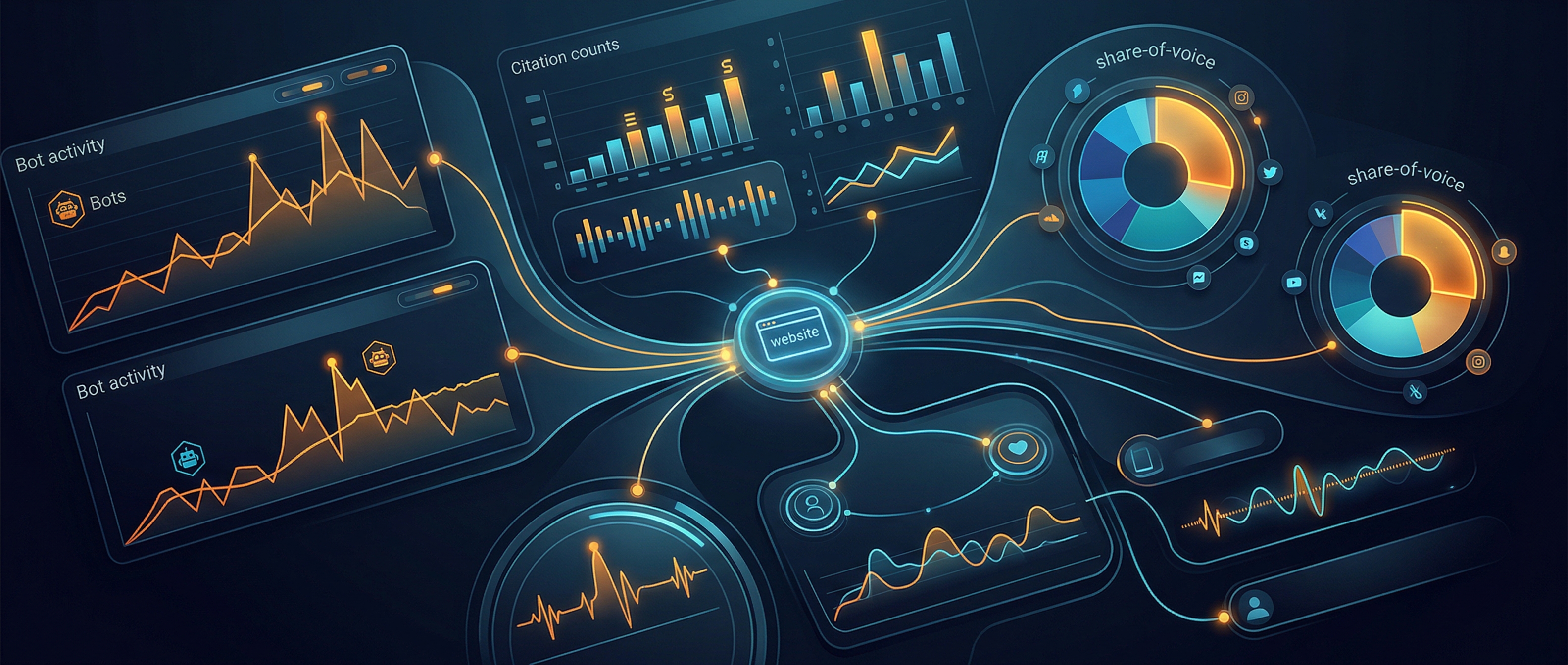
AI visibility monitoring has two sides: what AI bots crawl on your site (input) and what AI platforms cite in their answers (output). Measuring only one side gives you half the picture. This guide covers both, from share of voice calculation to citation tracking to building a dashboard that ties it all together.
Your CMO asks: "What is our share of voice in AI search?" You open Google Analytics. Nothing useful. You check Search Console. It tracks rankings, not AI citations. You try ChatGPT manually and find your brand mentioned once out of ten tries. Is that 10%? Is that good?
Nobody knows, because traditional measurement tools were built for a world where one search engine controlled 90%+ of discovery. AI search has shattered that model. ChatGPT, Perplexity, Claude, and Google AI Mode each pull from different source pools and produce different citations for the same query. The cross-platform URL overlap is just 1.4% (Lee, 2026a). A single snapshot on one platform tells you almost nothing about your actual AI visibility.
This guide is a complete framework for AI visibility monitoring. It covers what to measure, how to calculate AI share of voice, how to track brand mentions across platforms, which tools work, and how to build a dashboard that brings it all together for stakeholders and clients.
For background on how AI platforms select sources differently, see What AI Platforms Actually Cite. For a step-by-step audit of your competitive positioning, see AI Competitive Audit Guide.
🔄 WHAT AI VISIBILITY MONITORING IS: INPUT VS. OUTPUT
AI visibility monitoring tracks two fundamentally different data streams. Most people only think about one of them.
Input side: What AI bots crawl on your site. AI platforms send crawlers before they can cite you. ChatGPT uses GPTBot and OAI-SearchBot. Perplexity uses PerplexityBot. Claude uses ClaudeBot. Google AI Mode inherits from Googlebot. Monitoring which pages these bots visit, how often, and whether coverage is growing gives you a leading indicator of what content is entering their retrieval systems.
Output side: What AI platforms cite in their answers. Once content is ingested, does the AI actually recommend it? Output monitoring means querying AI platforms for your target topics and checking whether your URLs appear in the response citations. This is the lagging indicator, but it is what drives traffic and brand visibility.
These two streams create four states for any page on your site:
| State | Crawled? | Cited? | What It Means | Action |
|---|---|---|---|---|
| Active asset | Yes | Yes | Working as intended | Monitor and maintain |
| Untapped potential | Yes | No | Bots read it but do not recommend it | Optimize content structure |
| Stale citation | No | Yes | Cited from cached index; will decay | Update content, fix crawl signals |
| Invisible | No | No | AI platforms do not know it exists | Fix crawl access, add to sitemap |
The most actionable state is "untapped potential." These pages get actively crawled but never cited. The gap between crawl and citation is where optimization makes the biggest difference.
The Bottom Line: Crawl monitoring tells you what AI platforms can cite. Citation monitoring tells you what they do cite. You need both. A page that gets crawled but never cited has a content problem. A page that gets cited but never crawled has a caching problem that will eventually cause the citation to disappear.
📐 AI SHARE OF VOICE: DEFINITION AND CALCULATION
Traditional share of voice in SEO measures the percentage of organic impressions or clicks your brand captures for target keywords. It is a single-platform metric: you track Google, and Google alone represents "search."
AI share of voice is fundamentally different. It measures the percentage of AI-generated responses where your brand or content is cited as a source. Because each AI platform operates an independent retrieval system, AI SOV must be measured per platform and then aggregated.
The formal definition:
AI Share of Voice = (Query sessions where your brand/URL is cited) / (Total query sessions tested) x 100
Three factors make this harder than it sounds:
Session variability. AI platforms do not return identical results every time. ChatGPT cited the same sources only 61.9% of the time for identical queries (Lee, 2026a). You need multiple sessions per query.
Platform independence. With 1.4% cross-platform URL overlap (Lee, 2026a), your SOV on ChatGPT tells you nothing about Perplexity. Measure each platform separately.
Intent segmentation. Informational queries draw from Wikipedia and .gov/.edu domains. Discovery queries draw from review aggregators and Reddit. Your SOV varies by intent category.
Step-by-Step Calculation
Step 1: Define your query set. Select 20 to 50 queries your brand should own. Mix intent types: informational ("what is [topic]"), discovery ("best [product category]"), comparison ("[brand A] vs [brand B]"), and validation ("is [brand] worth it").
Step 2: Run multi-session tests. For each query, run 10 independent sessions on each platform. Open a new chat every time. Record whether your brand or URL appears in citations, and note the citation position.
For 30 queries across 4 platforms at 10 sessions each, that is 1,200 total observations. This is the minimum for statistical reliability given the session variability in the research.
Step 3: Calculate per-platform SOV. For each platform:
Platform SOV = (Sessions with your brand cited) / (Total sessions on that platform) x 100
Example for a B2B SaaS brand testing 30 queries on ChatGPT:
| Metric | Value |
|---|---|
| Total queries | 30 |
| Sessions per query | 10 |
| Total sessions | 300 |
| Sessions with brand citation | 42 |
| ChatGPT SOV | 14.0% |
Step 4: Calculate weighted aggregate SOV. Not all platforms carry equal weight. Weight by estimated market share or audience relevance:
| Platform | Estimated AI Search Share (2026) | Weight |
|---|---|---|
| ChatGPT | 35% | 0.35 |
| Google AI Mode | 30% | 0.30 |
| Perplexity | 20% | 0.20 |
| Claude | 10% | 0.10 |
| Gemini | 5% | 0.05 |
Weighted AI SOV = (ChatGPT SOV x 0.35) + (Google AI Mode SOV x 0.30) + (Perplexity SOV x 0.20) + (Claude SOV x 0.10) + (Gemini SOV x 0.05)
Step 5: Segment by intent. Break your aggregate SOV into intent categories to find where you are strong and where you are losing ground:
| Intent Category | Your SOV | Top Competitor SOV | Gap |
|---|---|---|---|
| Informational | 18% | 24% | -6% |
| Discovery | 8% | 31% | -23% |
| Comparison | 22% | 19% | +3% |
| Validation | 35% | 12% | +23% |
A single aggregate number would hide the insight that this brand dominates validation queries but is nearly invisible for discovery queries.
The Bottom Line: AI share of voice is not one number. It is a matrix: platforms on one axis, query intent categories on the other. The calculation is straightforward. The discipline is running enough sessions to produce signal, not noise.
🔍 TRACKING BRAND MENTIONS ACROSS PLATFORMS
Each AI platform has different citation behavior, different retrieval architecture, and different monitoring requirements.
Platform-by-Platform Tracking
ChatGPT. Open the web browser version (not the API) with web search enabled. Enter target queries and check both the response text and source citations. Lee (2026a) found API and web UI citation behavior differ significantly: Reddit appeared in 0% of API citations but up to 15.6% of web UI sessions. If you monitor only through the API, your data will not match what real users see.
Perplexity. Uses a pre-built index and displays numbered inline citations, making it the easiest platform to audit. Check both inline citations and the source sidebar. Perplexity has a strong freshness bias, so recently updated content gets picked up faster here.
Claude. Performs live page fetches using ClaudeBot and respects robots.txt strictly. Citation behavior is less consistent than ChatGPT or Perplexity. If you block ClaudeBot, you will never appear on this platform.
Google AI Mode. Inherits from the Google Search index via Googlebot. Check AI-generated summaries at the top of search results. Sources in the AI summary often differ from the organic results below them.
Platform Comparison
| Attribute | ChatGPT | Perplexity | Claude | Google AI Mode |
|---|---|---|---|---|
| Citation format | Inline + footnotes | Numbered inline | Inline (variable) | Linked sources in summary |
| Retrieval method | Live fetch via Bing | Pre-built index | Live fetch | Google Search index |
| Bot to track | GPTBot, OAI-SearchBot | PerplexityBot | ClaudeBot | Googlebot |
| API vs. web gap | Significant | Moderate | Unknown | N/A |
| Freshness sensitivity | Moderate | High | Moderate | Moderate |
| Citation consistency | Moderate (61.9%) | Higher | Lower | Higher (tied to index) |
Sentiment Matters, Not Just Frequency
Being mentioned is necessary but not sufficient. The way your brand is described changes the business impact:
| Mention Type | Example | Business Impact |
|---|---|---|
| Positive recommendation | "Brand X is widely regarded as the best option" | High conversion potential |
| Neutral mention | "Brand X is one of several options" | Awareness value only |
| Competitive displacement | "While Brand X is popular, Brand Y offers better value" | Direct competitive threat |
| Contextual authority | AI cites your content as a source (not your brand as a product) | Thought leadership signal |
Manual querying is currently the only reliable way to capture sentiment nuance. Automated tools detect URL presence but cannot assess recommendation tone.
The Bottom Line: Track both citation frequency and citation sentiment. A brand appearing in 80% of sessions with neutral mentions has a different strategic position than one appearing in 40% of sessions with strong positive recommendations.
⚠️ THE CONSISTENCY PROBLEM: WHY 10+ SESSIONS MATTER
The biggest mistake in AI citation monitoring is treating a single query session as ground truth. AI platforms are non-deterministic. The same query submitted 10 minutes apart can produce different citations because of temperature settings, index updates, session context, A/B testing, and geographic variation.
Lee (2026a) documented a Jaccard similarity of 0.619 within ChatGPT, meaning roughly 38% of citations change between identical queries. Across platforms the overlap drops to 1.4%. A single snapshot is statistically meaningless.
| Sessions per Query | What You Learn | Reliability |
|---|---|---|
| 1 | Whether the brand appeared that one time | Anecdotal only |
| 2 to 3 | A directional signal | Low confidence |
| 10+ | A citation frequency rate (e.g., "mentioned in 70% of sessions") | Statistically useful |
| 25+ | High-confidence competitive benchmarking | Research-grade |
What Drives High vs. Low Consistency
| Factor | High Consistency (80%+) | Low Consistency (Under 30%) |
|---|---|---|
| Content structure | Clear, front-loaded value propositions with structured data | Buried key points, no schema markup |
| Retrieval indexing | Page is in the platform's pre-built index | Page requires live fetch (session-dependent) |
| Query intent match | Brand directly answers the query intent | Brand is tangentially relevant |
| Source authority | Multiple independent sources reference the brand | Single self-referential source |
| Content freshness | Recently updated, actively crawled | Stale content, low crawl frequency |
Query intent was the strongest aggregate predictor of which sources get cited (Lee, 2026a). Brands that align directly with the intent behind a query, not just the keywords, appear with higher consistency. For a deep dive into what makes content citable, see What Gets You Cited by AI, Explained.
The Bottom Line: A single query session tells you nothing about consistency. You need repeated measurements to distinguish between brands that have earned a stable AI presence and brands that appear through randomness. Fewer than 10 sessions per query per platform is unreliable.
🛠️ MONITORING TOOLS: FOUR APPROACHES COMPARED
No single tool covers both sides of AI visibility monitoring. Here are the four methods available in 2026, with their strengths and limits.
Approach 1: Manual Querying
Type queries into each platform and check whether your site appears. Zero cost, but does not scale. For 100 queries across 4 platforms at 10 sessions each, that is 4,000 individual sessions. At 2 minutes per session, it takes over 130 hours per cycle.
Approach 2: API-Based Citation Scraping
Automated tools query AI platforms through APIs and parse responses for citations. Scales to thousands of queries, but the API vs. web UI gap is a serious limitation. API-based scraping systematically misses Reddit citations and other web-UI-specific sources. The data is not wrong, but it is incomplete.
Approach 3: Server-Side Crawl Monitoring
Instead of querying AI platforms, this monitors what AI crawlers do on your infrastructure. By analyzing server logs or using tools like BotSight, you see which bots visit, which pages they read, and how often they return. The data is deterministic (no sampling variance) and acts as a leading indicator: increased crawl frequency predicts future citation potential.
Approach 4: Third-Party Monitoring Platforms
SaaS tools that combine API querying, SERP tracking, and crawl analysis into dashboards. Turnkey setup with historical tracking, but methodology is often a black box and platform coverage varies.
Tool Comparison
| Feature | Manual Querying | API Scraping | Crawl Monitoring (BotSight) | Third-Party Platforms |
|---|---|---|---|---|
| What it tracks | Output (citations) | Output (citations) | Input (crawls) | Varies |
| Platforms covered | Any you test | Depends on API access | All bots hitting your server | Typically 2 to 4 |
| Data freshness | Real-time | Hourly to daily | Real-time (continuous) | Daily to weekly |
| Scalability | Low (dozens) | High (thousands) | Unlimited (passive) | Medium to high |
| Accuracy | High (what users see) | Moderate (API does not equal web UI) | High (server-side truth) | Varies |
| Cost | Free (time cost) | Per-query or subscription | Subscription | Subscription |
| Leading vs. lagging | Lagging | Lagging | Leading | Varies |
The Bottom Line: Crawl monitoring tells you what AI platforms are reading. Citation scraping tells you what they are outputting. The combination of both is what gives you an actionable monitoring system. For a complete walkthrough of AI bot tracking, see AI Bot Tracking: The Complete Guide.
📊 BUILDING AN AI SEARCH ANALYTICS DASHBOARD
Google Analytics 4 cannot see AI bots. It relies on JavaScript execution, which AI crawlers do not perform. They send HTTP requests, parse raw HTML, and leave. Zero events fire. This is not a configuration issue. It is a structural limitation. Your GA4 dashboard shows a flat line while GPTBot, ClaudeBot, and PerplexityBot scan your content thousands of times per month.
A complete AI search analytics dashboard tracks four data layers:
Layer 1: Bot Crawl Activity (Input Side)
This is the foundation. Key metrics include total AI bot requests per day/week/month, requests by bot, top crawled pages, crawl velocity trend, new bot detection, and crawl-to-page ratio (what percentage of your site gets crawled).
Layer 2: Citation Appearances (Output Side)
Key metrics include citation count by platform, citation rate by query category, citation position (primary source vs. footnote), competitor citation frequency, and citation stability (consistent vs. intermittent).
Layer 3: AI Share of Voice
Key metrics include your citation percentage vs. total citations for tracked queries, share of voice by platform, share of voice by topic, and trend over time.
Layer 4: Content Performance by Platform
Not all content performs equally across platforms. A page that Perplexity cites heavily may get zero citations from ChatGPT. Key metrics include top cited pages by platform, pages crawled but never cited (untapped potential), pages cited but with declining crawl frequency (staleness risk), and content format analysis.
| Dashboard Layer | Data Source | Update Frequency | What It Tells You |
|---|---|---|---|
| Bot crawl activity | Server logs / BotSight | Real-time | What AI platforms are reading |
| Citation appearances | API sampling / manual queries | Weekly | What AI platforms are recommending |
| AI share of voice | Aggregated citation data | Monthly | How you compare to competitors |
| Content performance | Combined crawl + citation | Weekly | Which content works on which platform |
Integrating with Existing SEO Tools
Google Search Console. Compare GSC query data with AI citation data for the same terms. Lee (2026a) found that Google Top-3 rankings showed poor predictive value for AI citations (7.8% for ChatGPT API), but domain-level alignment reached 28.7% to 49.6%. Pages that rank well on Google but are not cited by AI, and vice versa, are your highest-opportunity gaps.
Bing Webmaster Tools. ChatGPT's search feature is powered by Bing's index. Pages missing from Bing's index are effectively invisible to ChatGPT Search. Verify your key pages are indexed in Bing, not just Google.
The Bottom Line: A dashboard that only shows crawl data is half the picture. A dashboard that only shows citations is the other half. The cross-channel gaps between traditional search performance, AI crawl activity, and AI citation data are where the biggest opportunities hide.
📋 REPORTING FOR AGENCY CLIENTS
If you manage AI visibility for clients, your reports need to communicate clearly to non-technical stakeholders. Here is a four-section structure that works at monthly cadence.
Section 1: Executive Summary. Lead with the AI Visibility Score (single number, trend arrow, month-over-month change). Follow with weighted AI SOV across all platforms, total queries monitored, and the single most important action item.
Section 2: SOV by Platform and Intent.
| Platform | SOV | Trend | Top Competitor | Competitor SOV |
|---|---|---|---|---|
| ChatGPT | 12% | Up | Competitor A | 18% |
| Perplexity | 19% | Up | Competitor B | 25% |
| Claude | 8% | Flat | Competitor A | 14% |
| Google AI Mode | 16% | Up | Competitor C | 22% |
Break down by informational, discovery, comparison, and validation queries. Flag the intent categories where the client's gap to the leading competitor is widest. Discovery queries are almost always the biggest gap.
Section 3: Crawl Activity Dashboard. Show AI bot crawl frequency, page coverage, and the four components of the AI Visibility Score (bot diversity, crawl frequency, recrawl rate, page coverage, each scored 0 to 25 for a 0-to-100 composite). Include specific action items for any component below 20/25.
Section 4: Recommendations. Every recommendation ties to a specific data point:
- "Page X gets crawled 150 times/month by GPTBot but has zero citations. Recommend adding structured data and comparison tables."
- "Crawl frequency from PerplexityBot dropped 40%. Recommend checking robots.txt and sitemap freshness."
- "Competitor Y gained 3 new citations for [query]. Their cited page includes data tables our page lacks."
Reporting Cadence
| Report Type | Frequency | Primary Audience | Key Sections |
|---|---|---|---|
| Executive snapshot | Monthly | C-suite / VP Marketing | Visibility Score, SOV, top wins |
| Tactical report | Bi-weekly | Marketing managers | Crawl trends, citation changes, action items |
| Technical audit | Quarterly | SEO / development teams | Crawl access, schema compliance, content gaps |
| Alert-based | As needed | Account managers | Significant drops, new competitor citations |
For managed AI visibility monitoring and client reporting, explore our AI SEO services. To check your current baseline, try our free AI Visibility Quick Check.
The Bottom Line: Agency reporting should answer three questions: "How are we doing?" (Visibility Score and share of voice), "What changed?" (crawl and citation trends), and "What should we do next?" (prioritized recommendations tied to data).
📊 BENCHMARKS BY VERTICAL
AI share of voice varies dramatically by industry. These benchmarks are directional estimates, not precise targets. Your specific numbers depend on your query set, competitor landscape, and measurement methodology.
| Vertical | Typical Brand SOV Range | Dominant Platform | Notes |
|---|---|---|---|
| B2B SaaS | 8 to 20% | ChatGPT, Perplexity | Technical content performs well |
| E-commerce (DTC) | 5 to 15% | Google AI Mode, Perplexity | Product schema boosts citation (Lee, 2026c) |
| Healthcare/Medical | 3 to 12% | Google AI Mode | .gov/.edu sources dominate |
| Financial Services | 5 to 18% | ChatGPT, Google AI Mode | Comparison queries most competitive |
| Local Services | 10 to 30% | Google AI Mode | Validation queries drive highest SOV |
| Technology/AI | 12 to 35% | Perplexity, ChatGPT | Fast content turnover rewards freshness |
Do not compare your SOV to another vertical's benchmark. A 10% SOV in healthcare is exceptional. A 10% SOV in technology might be below average. Always separate branded and non-branded queries, because branded queries inflate SOV artificially.
❓ FREQUENTLY ASKED QUESTIONS
How many query sessions do I need for reliable AI share of voice data?
Minimum 10 sessions per query per platform. With ChatGPT's 61.9% within-platform consistency (Lee, 2026a), roughly 4 out of 10 sessions produce different citation sets. Fewer than 10 sessions means random variation dominates your data. For high-stakes reporting (board decks, investor updates), use 20 to 25 sessions per query.
Can I use API access instead of the web UI to measure AI share of voice?
Yes, but with a systematic bias. Lee (2026a) found Reddit received zero API citations but 8.9% to 15.6% through the web UI. Google AI Mode showed 0% Reddit via API versus 44% via web UI. API measurement is valid but does not reflect what real users see. If competitors have strong Reddit presence, API-only measurement undercounts their SOV.
Is there a "Google Search Console" equivalent for AI search?
No. As of April 2026, no AI platform provides a webmaster-facing dashboard showing citation data. The closest equivalent is crawl-side monitoring (tracking bot activity on your server via tools like BotSight), which gives you the input side. For the output side, you need third-party tools or manual monitoring.
What is the difference between AI share of voice and an AI Visibility Score?
AI SOV measures the output: how often your brand appears in AI responses. The AI Visibility Score measures the input: how thoroughly AI crawlers ingest your content, scored across bot diversity, crawl frequency, recrawl rate, and page coverage. The Visibility Score is a leading indicator. Low crawl activity today predicts low citations next month.
How often should I measure AI share of voice?
Monthly for most businesses. For fast-moving industries (news, technology, finance), bi-weekly provides more timely signal. For stable industries (legal, healthcare), quarterly may suffice. Crawl monitoring should run continuously since it is passive. The key is consistency: use the same query set and session count every period so changes reflect actual shifts, not methodological noise.
How quickly do citation changes show up after I optimize a page?
It depends on crawl frequency. If AI bots already crawl the page regularly (weekly or more), citation changes can appear within 1 to 2 weeks of content updates. If crawl frequency is low, it may take 4 to 6 weeks. Crawl monitoring shows this timeline: once you see a fresh crawl after your update, start checking for citation changes the following week.
Can I build an AI analytics dashboard using only free tools?
Partially. You can track AI bot crawl activity for free using server log analysis. Google Search Console and Bing Webmaster Tools are free. The gap is on the citation side: no free tool systematically tracks AI platform citations at scale. Manual spot-checks work for a few dozen queries but do not scale. A hybrid approach (free tools for crawl data, dedicated tool for AI-specific analytics) works for most sites. Start with our free AI Visibility Quick Check to see where you stand.
Should I weight all AI platforms equally when calculating aggregate SOV?
No. Weight by relevance to your audience. If your customers primarily use ChatGPT, weight it higher. The weights in this guide (ChatGPT 35%, Google AI Mode 30%, Perplexity 20%, Claude 10%, Gemini 5%) are rough 2026 market share estimates. Adjust based on your analytics: if you see referral traffic from Perplexity but not from Claude, that tells you where your audience is.
📚 REFERENCES
- Lee, A. (2026a). "Query Intent and Google Rank as Joint Predictors of AI Citation: A Multi-Platform Observational Study." Preprint v6. DOI
- Lee, A. (2026c). "I Rank on Page 1: What Gets Me Cited by AI?" Preprint. Paper | Dataset
- Aggarwal, P., Murahari, V., Rajpurohit, T., Kalyan, A., Narasimhan, K., & Deshpande, A. (2024). "GEO: Generative Engine Optimization." KDD 2024. DOI