
AI SEO EXPERIMENTS
Google Says GEO Is Just SEO. We Checked the Receipts From Every Other Search Vendor.
Google just published its first official guide to optimizing for AI search. Its core claim is that AI features run on "core Search ranking and quality systems," so optimizing for AI is just SEO. Most of the guide's specific advice is correct. The one claim we dispute is that framing sentence. Our pre-registered study of 94,384 AI citation events shows AI citation does not follow Google rank the way the guide implies, and three other search vendors (Microsoft, Ahrefs, and an independent test lab) have published evidence of a separate retrieval system that Google's guide does not mention.
On May 15, 2026, Google Search Central published the AI Optimization Guide. It is the first time Google has said anything official about optimizing for generative AI search.
The headline message is one sentence: "From Google Search's perspective, optimizing for generative AI search is optimizing for the search experience, and thus still SEO." The reason given is that Google's AI features are "rooted in our core Search ranking and quality systems."
We run a research lab that studies AI citation. We have analyzed close to 100,000 AI citation events across ChatGPT, Claude, Perplexity, and Google AI Mode. So we read this guide closely.
Here is the short version. Google is right about almost everything it tells you NOT to do. Google is wrong about the one sentence it uses to explain why. And every other major search vendor has now published evidence that points the other way.
🧾 Start with the receipts
Google's guide is not the only vendor document on this topic. It is the latest. The others do not agree with it.
| Vendor | What they published | What it says |
|---|---|---|
| Microsoft / Bing (May 2026) | "Evolving role of the index" | Search indexing helps humans pick what to read. "Grounding indexing is being built to help AI systems decide what to say." A separate index. |
| Microsoft Advertising (Oct 2025) | AI content optimization guide | "AI assistants don't read a page top to bottom like a person would. They break content into smaller, usable pieces." |
| Ahrefs (May 2026) | First quasi-experimental schema test | Adding schema to pages already cited by AI produced no causal lift. 1,885 test pages, 4,000 matched controls. |
| SearchVIU (early 2026) | Fetch-time parsing test | None of ChatGPT, Claude, Perplexity, Gemini, or Google AI Mode parsed schema markup at fetch time. |
Read that table again. Microsoft Advertising says AI breaks content into pieces. Google's new guide says you do not need to worry about "chunking" content. Those are not the same picture of how the machine works.
This matters because Google is now the only major search vendor still publicly arguing that AI optimization is just SEO. Microsoft is describing a second index. Ahrefs and SearchVIU are publishing test results that only make sense if AI retrieval is its own thing. Google's guide does not engage with any of that.
So who is right? We can settle part of this with our own measurements.
✅ Where Google is right (and we will say so plainly)
The easy thing to do with a competitor's guide is to attack all of it. We are not going to do that, because most of it is correct, and pretending otherwise would make us the unreliable narrator.
Google lists six things you do NOT need to do. We agree with five of them, and we agree with the sixth with one footnote.
1. You do not need an llms.txt file or AI-specific markup. Correct. There is no evidence any major AI platform reads these files to decide what to cite.
2. You do not need to rewrite your content "for AI." This one we can prove. We measured how closely AI answer sentences match the source text they cite. Across 18,943 citation events on 6,706 URLs, the average word overlap (Jaccard) between an AI answer sentence and the chunk it cited was 0.08. ChatGPT 0.082. Claude 0.085. Google AI 0.080. Perplexity 0.082. Zero events out of 18,943 reached a "near-quote" overlap. The AI almost never repeats your wording. It restates the idea in its own words. So writing "quotable copy for the AI" is wasted effort. Google is right here, and we have the number.
3. You do not need inauthentic brand mentions. Correct, and it matches our data. In our content study, recycled "rehash" content was cited at the lowest rate of any category (a 0.25x lift, roughly a 75% penalty versus baseline). Padding the web with low-value mentions does not move AI citation.
4. There is no ideal page length. Correct as a rule, with a mechanism Google does not give you. We will come back to this in the practical section, because the way length actually works is useful to understand.
5. Structured data is not required for generative AI search. This is the careful one. Google says schema is not required for AI answers. Our current evidence agrees with that specific claim. Ahrefs ran the first controlled test and found schema added no causal lift on pages already being cited. SearchVIU found that no major AI system parses schema at fetch time. Our own earlier "schema is a GEO lever" claims were corrected after we controlled for a data confound, and they did not survive. So we now treat schema as a retrieval-layer signal (it can help a page get into the pool an AI draws from, mostly through the search index) and not as a lever that lifts a page already in that pool. Google's "not required for the AI answer" is true. The disagreement is narrower than it looks, and we will get to it.
6. You do not need to manually chunk your content. Correct as writing advice. You should not chop your articles into tiny fragments. But "you do not need to chunk" is true for the writer and not true for the machine, and that gap is where the real story is.
That is a lot of agreement. We are on record: most of Google's "do not bother" list is good advice. Now the part we dispute.
⚠️ The one sentence we dispute
Google's framing sentence is: AI features are "rooted in our core Search ranking and quality systems," therefore optimizing for AI is just SEO.
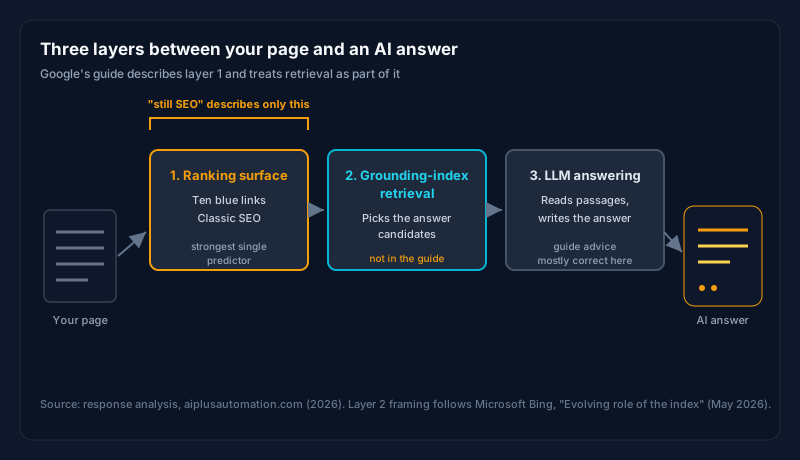
This collapses three different things into one. There are three layers between your page and an AI answer:
- The ranking surface. The ten blue links. This is classic SEO.
- The grounding-index retrieval layer. The system that decides which pages even become candidates for an AI answer. Microsoft calls this "grounding indexing."
- The LLM answering layer. The model that reads the candidate passages and writes the answer.
Google's guide talks as if layer 1 and layer 2 are the same system. Our measurements say they are not.
The measurement: rank predicts citation, but most citations land outside the top of Google
This is the part people get wrong in both directions, so we will be precise.
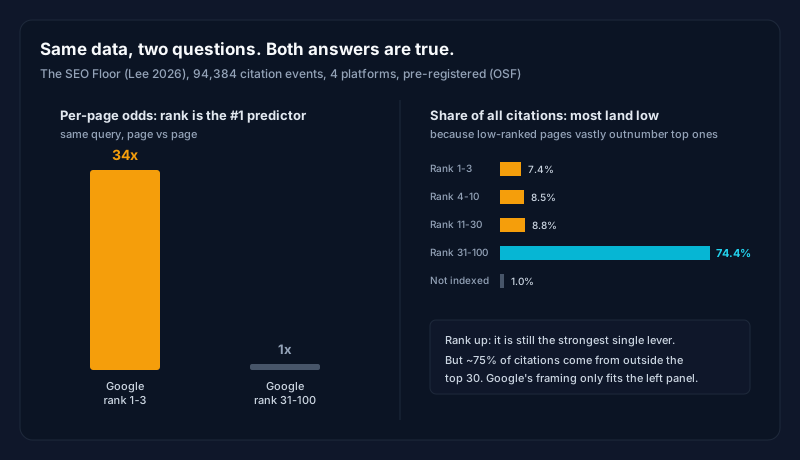
We ran a pre-registered study (Study A, OSF DOI 10.17605/OSF.IO/FMSRD) on 94,384 AI citation events across all four platforms. We recorded, for every cited page, where it ranked in Google for the matching query. Here is the full distribution.
| Tier | Google rank of the cited page | Share of AI citations |
|---|---|---|
| 1 | Rank 1 to 3 | 7.4% |
| 2 | Rank 4 to 10 | 8.5% |
| 3 | Rank 11 to 30 | 8.8% |
| 4 | Rank 31 to 100 | 74.4% |
| 5 | Not in Google's index at all | 1.0% |
Two facts live in this table at the same time, and you need both.
Fact one: rank is the single strongest predictor we measure. When you hold the query constant and compare two pages, the higher-ranked page is far more likely to be cited. In our per-page analysis, a page in Google's top 3 is roughly 34 times more likely to be cited than a page ranked 31 to 100 for the same query. No single on-page feature in our 200-column dataset comes close to that. We covered this gradient in detail in Google Rank vs AI Citation. Rank is the number one lever.
Fact two: most citation volume still lands outside the top of Google. About 75% of all AI citations go to pages ranked below 30. Why? Because there are vastly more low-ranked pages than top-3 pages. Each one is individually unlikely to be cited, but together they are most of the web, so together they win the volume count.
Both are true. Rank is the strongest per-page predictor AND three out of four citations come from pages Google does not rank highly. If AI features were simply reading off "core Search ranking," the distribution should pile up at the top and fade out. It does the opposite. The shape inverts.
Tier 5: pages Google does not index, but AI cites anyway
Look at the last row of the tier table. One percent of citations went to pages that are not in Google's index at all. In our corpus that was 810 unique URLs, confirmed present on the public CommonCrawl archive. 678 of those 810 (83.7%) were cited within the last 30 days of our collection window.
If the AI retrieval stack were a subset of "core Search ranking and quality systems," this set should be empty. You cannot rank a page Google has not indexed. Yet AI platforms cited these pages. The retrieval system is reaching content Google's ranking system does not surface.
Indexing is not retrieval is not citation
We ran a separate experiment to test whether all three layers really collapse into one. We put an identical, factual passage in two places: once in the main body of a page, once buried in the page footer. Then we asked ChatGPT, Perplexity, Claude, and Gemini a question that passage answered.
When the passage was in the body, all four found it (match scores 96 to 100). When the exact same passage was in the footer, all four failed to find it and made up alternative answers instead (match scores 0 to 12). Same page. Same indexing. Same words. Different retrieval outcome based purely on where the text sat.
Indexing, retrieval, and citation are three different events. Google's framing treats them as one pipeline called "ranking." Our footer test shows they come apart.
🧩 The chunking gap
Back to chunking, because this is where Google's writing advice and Google's framing pull in opposite directions.
Google says: do not break your content into tiny pieces, the systems understand broader context. As advice to a writer, that is correct. You should write whole, coherent articles.
But the retrieval system consumes your page in pieces no matter how you wrote it. Microsoft Advertising said this out loud in October 2025: "AI assistants don't read a page top to bottom like a person would. They break content into smaller, usable pieces."
We measured what happens inside those pieces. We compared 43,276 cited chunks against 86,257 uncited chunks on the same URLs, so page-level quality is held constant. A few results:
- A chunk whose first sentence is a direct claim ("X is the most effective method for Y") gets cited 26.7% more often than one that opens with setup or context.
- Chunks dense with named entities (brand names, people, places) get cited about 10 to 12% more often.
- Chunks stuffed with statistics get cited about 11% LESS often. More numbers in a passage hurt it.
- List markers, question headings, and "direct answer" templates had no measurable effect.
None of those levers appear in Google's guide, because at the writer's level the advice is "do not chunk" and the conversation stops there. But the chunk your page gets cited from is decided by chunk-level structure, and that structure is different from what classic SEO ranking rewards. A writer who follows Google's guide literally never learns that a claim-led opening sentence is the strongest within-page citation lever we have measured.
This is not "writing for the AI" in the bad sense Google warns about. It is a structural response to a measured retrieval mechanism. The reader experience barely changes. The citation outcome changes a lot.
🛠️ What to actually do about it
You came here for actions, not a vendor argument. Here is the practical layer, and most of it does not contradict Google. It extends Google.
Be genuinely crawlable, or nothing else matters. When we re-crawled cited URLs, only 36.7% returned usable visible text. The rest failed on Cloudflare blocks, JavaScript-only rendering with no server-side HTML, and dead links. AI crawlers like ClaudeBot do not run JavaScript. If your content only exists after a browser runs JS, the AI cannot read it, no matter how good it is. This is Google's "be crawlable" point, but stronger: for AI, crawlability is not a ranking factor, it is the on/off switch.
Aim for Google rank, because it is still the #1 predictor. This is the part of Google's guide that holds. Ranking well genuinely raises your per-page citation odds. Just do not assume it is sufficient, because 75% of citations go to pages that did not rank well.
Lead chunks with the claim, not the windup. Start sections with the answer sentence. "The fastest method is X." Then explain. This is the single strongest within-page lever in our data, and it also happens to be good writing.
Use comparison structure where it fits. In our format analysis, comparison pages were cited at 22.1%, the highest of any format and about 76% above baseline. AI rewards structured decision-helping content. (Classic SEO rewards opinion and personality more, which is one more place the two systems diverge.)
Front-load long pages, not short ones. "Put the answer at the top" is real, but only for long content. Pages over 10,000 words keep 77.8% of their cited content in the first 40% of the page. Pages under 800 words have no meaningful "top." On a long guide, the answer goes high. On a short page, the whole page is the top.
Stop chasing schema as an AI citation lever. Use schema for rich results and for getting into the index. Do not expect it to lift a page that is already being cited. The controlled tests (ours, corrected; Ahrefs; SearchVIU) all point the same way now.
Do not over-optimize page speed for AI. In our data, the fastest 25% of pages were cited slightly less than the slowest 25%. Speed is a real user concern. It is close to noise for AI citation.
Tune per platform if a platform matters to you. The four platforms read pages very differently. Perplexity tends to cite one tight passage. Google AI Mode and Claude scatter citations across a page. Claude appears to run on a meaningfully different retrieval stack than the other three. "AI features on Google Search" is not one uniform thing, and treating it as one leaves lift on the table. We break this down in Is GEO Just Repackaged SEO?.
🧷 So is GEO just SEO?
Here is the honest answer, and it is more careful than either side usually gives.
Google's guide is right about most of what it tells you not to do. No magic files. No AI rewrites. No fake mentions. No magic word count. Schema is not an AI answer lever. We agree, on the record, with the evidence to back it.
Google's guide is wrong about the one sentence that frames all of it. AI citation does not run purely on "core Search ranking and quality systems." We can show a pre-registered citation distribution that inverts the shape that claim predicts, a set of cited pages Google does not index at all, and a footer experiment where indexing, retrieval, and citation come apart on a single page. And we are not alone. Microsoft is publicly describing a separate grounding index. Ahrefs and SearchVIU are publishing test results that only make sense if retrieval is its own layer.
The useful way to say it: most of Google's concrete advice is correct at the answering layer. The disagreement is whether the retrieval layer is "just SEO." The evidence, ours and three other vendors', says it is not. Optimize for Google rank, because it is the strongest single predictor. Then optimize for the retrieval layer Google's guide does not mention, because that is where 75% of citations actually come from.
❓ Frequently asked questions
Does Google's guide say schema markup is useless for AI? It says structured data is not required for generative AI search. That specific claim survives the current evidence. Schema can still help a page enter the index an AI draws from, and it still drives rich results. It is not a lever that lifts a page already being cited. Treat it as a retrieval-layer and rich-result signal, not an AI citation booster.
If 75% of AI citations are outside Google's top 30, why chase Google rank at all? Because per page, rank is the strongest predictor we measure (about a 34x odds gradient between top-3 and rank 31 to 100). The 75% number is about total volume across the whole web, where low-ranked pages win by sheer count. Ranking well genuinely raises your odds. It just is not the whole game. See Google Rank vs AI Citation.
Does Google's "no chunking" advice mean chunk structure does not matter? No. It means you should not physically chop your articles into fragments. The retrieval system still consumes your page in chunks regardless. A claim-led first sentence in a section is the strongest within-page citation lever we have measured (+26.7%). Write whole articles, but lead sections with the answer.
Is GEO different from SEO or not? Both. The advice overlaps a lot (be original, be crawlable, do not game it). The systems diverge on what they reward (rank sensitivity, content format, chunk-level structure) and AI reaches content Google does not index. It is not a repackaging scam, and it is not a separate magic discipline either. Full breakdown in Is GEO Just Repackaged SEO?.
What is the single most important thing from all of this? Be truly crawlable as static HTML. In our re-crawl, only 36.7% of cited URLs returned usable text. AI crawlers do not run JavaScript. If the AI cannot fetch your rendered content, none of the rest matters.
Want to know how your pages score against this?
For a fast self-serve check of how your pages score against the citation predictors in this article, run our AI Visibility Quick Check. It scores any URL against the research-backed factors above.
For a personal walkthrough of where your domain sits across ChatGPT, Claude, Perplexity, and Google AI Mode for your top queries, request a Free AI Visibility Video Audit. We pull your actual citation data and the comparison pool for your top queries, and we walk you through the highest-priority fixes on a recorded video. No deck. No sales call. Just the diagnosis.
References
- Google Search Central (2026). "AI Optimization Guide." The document this article responds to. Fetched 2026-05-15.
- Lee, A. (2026). "The SEO Floor: Measuring Google Rank Distribution of AI-Cited Pages." Preprint, pre-registered (OSF). 94,384 analytic AI citation events across 4 platforms. OSF pre-registration DOI: 10.17605/OSF.IO/FMSRD. Paper DOI: 10.5281/zenodo.19787654. Data DOI: 10.5281/zenodo.19787328.
- Lee, A. (2026). "I Rank on Page 1: What Gets Me Cited by AI?" Preprint v1. Position-controlled analysis of 10,293 pages. DOI: 10.5281/zenodo.19398158.
- Lee, A. (2026). "Query Intent, Not Google Rank: What Best Predicts AI Citation Behavior." Preprint v3. 3,251 real websites (UGC excluded), ChatGPT and Google AI Mode. DOI: 10.5281/zenodo.18653093.
- Internal sub-studies referenced: passage-location analysis (43,276 cited vs 86,257 uncited chunks; 18,943 paraphrase-overlap events on 6,706 URLs) and the text-position footer-burial experiment (4 platforms).
- Microsoft Bing (May 2026). "Evolving role of the index: From ranking pages to supporting answers."
- Microsoft Advertising (October 2025). "Optimizing your content for inclusion in AI search answers."
- Ahrefs (May 2026). "Schema markup and AI citations: a quasi-experiment." 1,885 test pages, ~4,000 matched controls.
- SearchVIU (early 2026). Fetch-time structured-data parsing test across 5 major AI systems.