
AI Understanding
What Is Generative Engine Optimization (GEO)?
What is generative engine optimization? (definition)
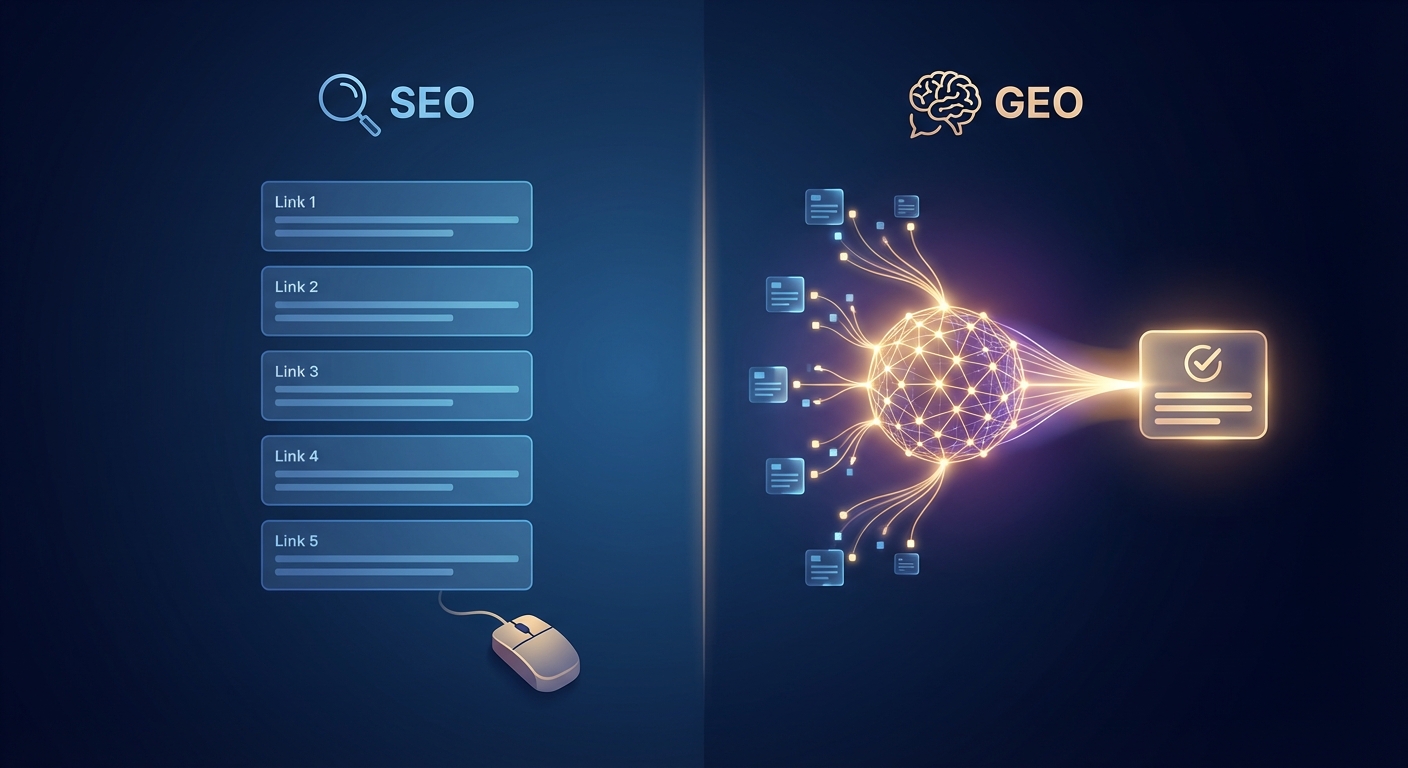
Generative Engine Optimization (GEO) is the practice of optimizing web content to be discovered, retrieved, and cited by AI-powered search systems (ChatGPT, Perplexity, Gemini, Claude).
Unlike SEO, which optimizes for ranking position in a list of links, GEO optimizes for selection as a source inside a generated answer.
When someone asks ChatGPT, "What is the best CRM for small business?" and it effectively cites TechRadar as its primary source, TechRadar has won the GEO game. The other 9 blue links on Google? They lost.
The Bottom Line: SEO gets you on the page. GEO gets you in the answer.
The Thesis: Much of the "GEO advice" circulating today is just recycled SEO principles. But our research, across 12 experiments and 14,000+ analyzed URLs, reveals optimization levers that have no equivalent in traditional SEO. GEO isn't just "SEO but for AI." It's a distinct discipline with its own mechanics.
Why GEO exists: SEO is the gate, GEO is the lever inside
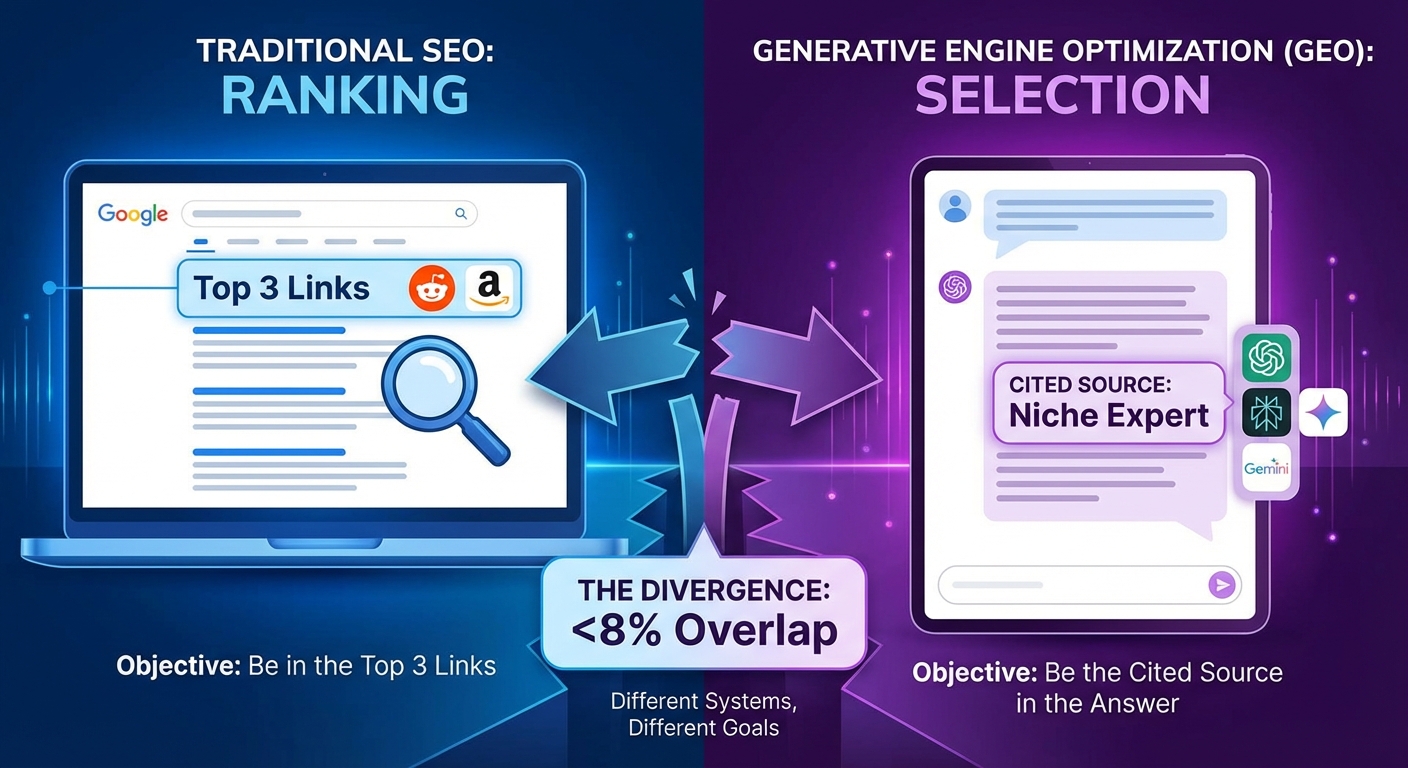
If Google rankings perfectly determined AI citations, GEO wouldn't need to exist. You would just "do SEO" and win everything. The reality is more specific: Google rank dominates per-page citation odds, but the citation pool extends far past Google's top 3, and a distinct set of GEO levers determines who wins inside the SEO gate and who breaks into the repeatable deep-tier cohort.
The data, from a 100,411-event comparison-pool study (Lee, 2026, Study A):
- Top-3 Google pages are roughly 34x more likely to be cited than rank 31-100 pages for the same query. This is the SEO gate.
- About 25% of citations come through that gate (Top-30 Google). These are stable, repeat-cited, multi-platform-consensus answers.
- About 17% are repeat-cited deep-tier pages. They don't rank well, but they get cited over and over because of distinct GEO levers (schema breadth, primary-source content, site-wide hygiene, niche specialization).
- About 58% are fuzzy-retrieval noise (one-shot, single-platform, no consistent pattern). Not targetable.
The 7.8% statistic, properly explained
You may have seen the headline: "ChatGPT only cites 7.8% of Google's Top-3 URLs." That is true and consistent with rank dominating per-page odds. AI reformulates conversational queries before retrieval, so the literal-query Top-3 is not what AI actually searches. Most cited URLs land outside the literal Top-3 because there are vastly more pages outside it than inside it. Both facts are true at the same time: rank dominates per-page odds, AND the surface URL-overlap statistic looks low because of denominator math. See our GEO vs SEO post for the full unpacking.
Reddit's split influence
Reddit appears in 51.8% of Google's Top-3 positions for product recommendation queries but is cited 0% via AI APIs and 17-44% via web UIs. Reddit's brand consensus correlates with AI brand recommendations at rho = 0.554 even when Reddit is not cited, because Reddit content is absorbed into AI training data (Reddit shadow corpus research). This is a separate phenomenon from the rank gradient and matters for any brand that wants to understand AI brand recommendations.
The Insight: GEO is a distinct discipline because the levers that work inside the SEO gate (schema breadth, content depth, site-wide hygiene) are different from the levers that get you to the SEO gate (traditional SEO). And the levers that earn repeat citation in the deep tier (niche specialization, domain-level concentration) are different from both.
How does GEO work? (4 pipelines, not one)
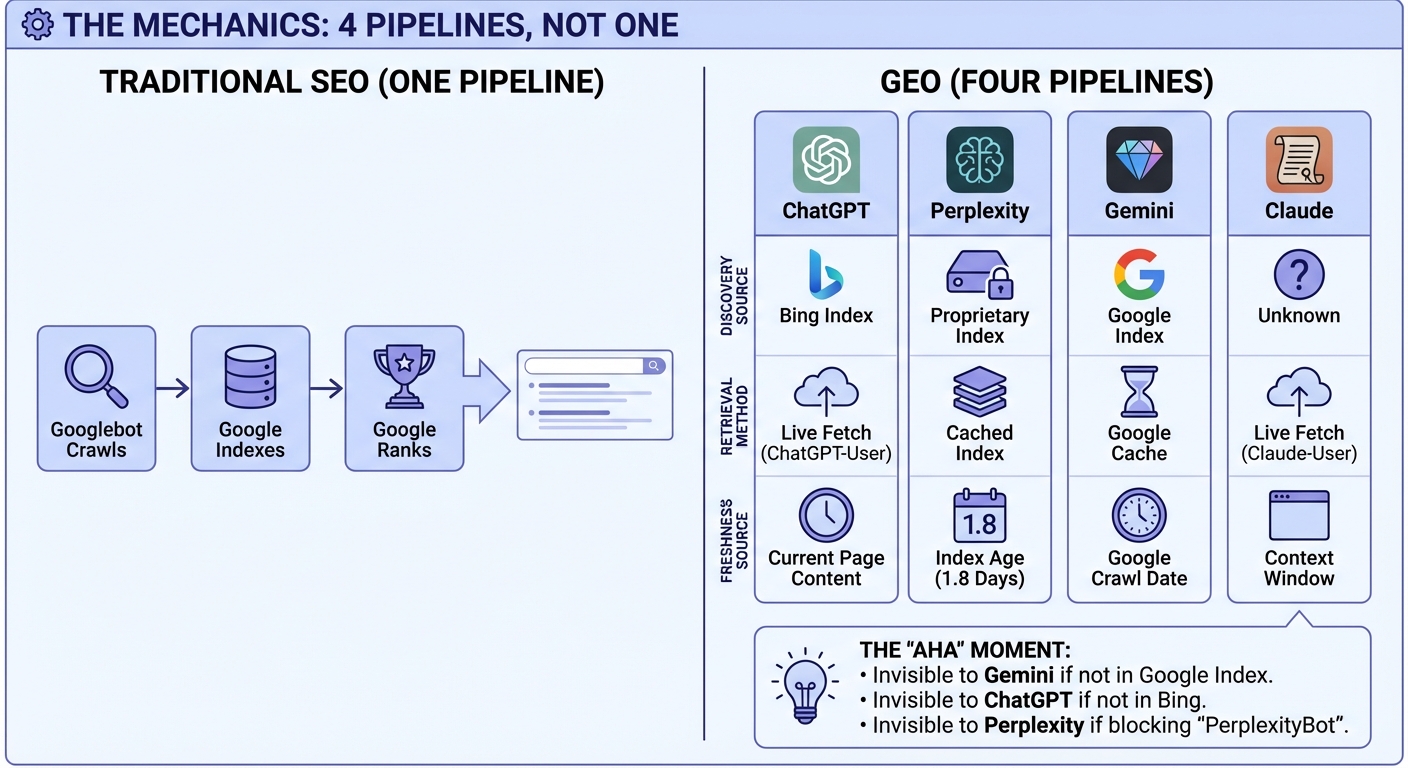
In traditional SEO, you optimize for one pipeline: Googlebot crawls → Google Indexes → Google Ranks.
In GEO, you are optimizing for four different pipelines simultaneously.
| Platform | Discovery Source | Retrieval Method | Freshness Source |
|---|---|---|---|
| ChatGPT | Bing Index | Live Fetch (ChatGPT-User) |
Current Page Content |
| Perplexity | Proprietary Index | Cached Index | Index Age (1.8 Days) |
| Gemini | Google Index | Google Cache | Google Crawl Date |
| Claude | Unknown | Live Fetch (Claude-User) |
Context Window |
The "Aha" Moment:
- To specific AI bots (like Gemini), you are invisible if you aren't in Google's index.
- To others (like ChatGPT), you are invisible if you aren't in Bing.
- And for Perplexity, you are invisible if you block
PerplexityBot—even if you rank #1 on Google.
The 6 levers of GEO
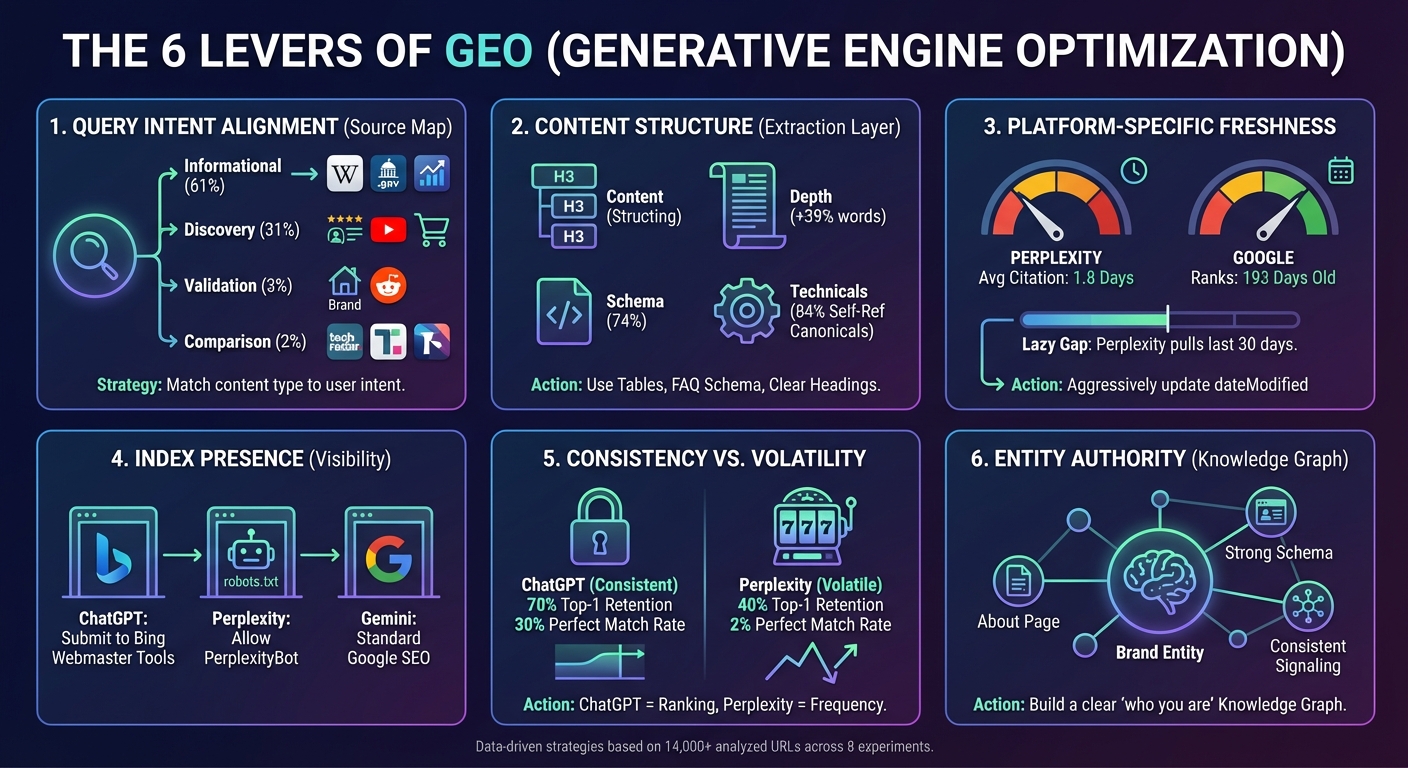
Most "AI SEO" advice is vague guessing ("Write helpful content!"). We prefer data. Across the 100,411-event SEO Floor study, the 19,556-query joint predictors paper, and earlier experiments totaling 165,000+ analyzed URLs, here are the 6 levers that actually move the needle.
1. Query Intent Alignment (The "Source Map")
We classified 19,556 queries and found that AI cites different types of sites based on what the user wants. For a deeper dive into how citation mechanics work, see our AI citation optimization guide.
- Informational Queries (61%): AI cites Wikipedia, .gov, and Data Sites.
- Strategy: Publish "What is" glossaries and data tables.
- Discovery Queries (31%): AI cites Review Aggregators and YouTube.
- Data: YouTube got 800+ citations in our test. Amazon got almost zero.
- Strategy: If you are a SaaS brand, you won't get cited directly. You must get listed on the review sites the AI trusts.
- Validation Queries (3%): AI cites Brand Homepages and Reddit.
- Strategy: Reddit presence matters most for validation and recommendation queries — it appears in up to 71% of Google AI Mode responses and 46% of Perplexity responses for "best X for Y" queries. Reddit also shapes AI recommendations through training data, even when it isn't cited.
- Comparison Queries (2%): AI cites Tech Publishers (TechRadar, PCMag).
- Strategy: You cannot win this with your own blog. You need PR.
2. Content Structure (The "Extraction" Layer)
AI engines don't "read" like humans. They "extract." Across the 100,411-event comparison-pool study (Lee, 2026, Study A), here are the per-feature odds ratios for citation, controlling for Google rank tier and vertical:
| Feature (per 1 SD increase) | Odds Ratio |
|---|---|
| Schema presence (5-type sum) | 1.31 |
| Primary-source score (original analysis vs aggregation) | 1.12 |
| Answer-first coverage (query terms in first 200 words) | 1.09 |
| Comparison signals (vs / versus / pros-cons) | 1.06 |
| List structure | 1.04 |
| Statistics density | 1.03 |
| Heading density per word | 0.94 |
Schema markup is the strongest single content-level lever by an order of magnitude. By type: Product, Review, FAQ all help; Article hurts.
Action: Deploy multiple relevant schema types per page (Article + FAQ + Organization at minimum, Product/Review where applicable). Skip Article schema on opinion content. Use comparison tables and clear "Best For..." headings.
3. Platform-Specific Freshness
How recent does your content need to be?
- Perplexity is obsessed with Newness. For high-velocity topics (news/tech), its average citation is just 1.8 days old. If your article is a week old, you are invisible.
- The "Lazy Gap": For medium-velocity topics (like "Best CRM"), Google ranks content that is 193 days old. Perplexity pulls content from the last 30 days.
- Opportunity: You can beat high-DA giants on Perplexity just by being the freshest update.
Action: For GEO, you must update your dateModified schema much more aggressively than for SEO.
4. Index Presence
You cannot get cited if the AI doesn't know you exist.
- ChatGPT: Submit your sitemap to Bing Webmaster Tools. (Yes, really).
- Perplexity: Check your
robots.txt. You must allowPerplexityBot. - Gemini: Just do standard Google SEO. It has no separate crawler.
5. Consistency vs. Volatility
We asked the same questions 3 times in a row to measure stability.
- ChatGPT is consistent (70% Top-1 retention). If you win a keyword, you tend to keep it.
- Perfect Match Rate: 30% (It often gives the exact same list).
- Perplexity is a particular "Slot Machine" (40% Top-1 retention).
- Perfect Match Rate: 2% (It almost never repeats itself).
- List Volatility: It swings wildly in list length (Standard Deviation: 1.8 vs ChatGPT's 0.3).
Action: Treat ChatGPT like SEO (Ranking). Treat Perplexity like Social Media (Frequency).
6. Entity Authority
AI models think in "Entities" (Concepts), not Keywords. We found that prompts using Brand Names ("Tell me about [Brand]") trigger much higher citation rates than generic prompts.
Action: Build a "Knowledge Graph" for your brand. Ensure you have a clear "About" page, strong schema markup, and consistent signaling across the web about who you are.
GEO vs AI SEO vs AEO (terminology)
You will hear many terms:
- AEO: Answer Engine Optimization.
- GEO: Generative Engine Optimization.
- AI SEO: Catch-all term.
We prefer GEO because it describes the engine (Generative). But the name matters less than the practice.
The Danger: Many agencies sell "AI SEO services" that are just traditional SEO packages with a new sticker. See how they actually compare in our research-backed AI SEO agency comparison. The Truth: If they aren't talking about Bing Indexing, Multi-Agent Logs, or Citation Levers, they aren't doing GEO. They are just doing SEO.
How to start with GEO (the playbook)
You don't need to rebuild your site. Just add the GEO layer.
Step 1: Audit Your Visibility Don't guess. Use BotSight to track which specific AI bots are crawling you.
- Are you missing ChatGPT? Check your Bing Index.
- Are you missing Perplexity? Check your content Freshness.
Step 2: Map Your Intents Build a content strategy designed for AI search. Look at your top keywords. Are they Informational? Commercial?
- If Commercial: Build comparison tables.
- If Informational: Build data-rich definitions.
Step 3: Structure for Robots Go to your top 10 pages. Add a summary table at the top. Add FAQ schema at the bottom. Make the facts easy to steal.
Step 4: Monitor the "Gap" Watch your Search Traffic (Google) vs your Bot Traffic (AI). The pages where Google ranks you but AI ignores you are your biggest opportunities.
The bottom line
Much of the advice online is hype. Ours is proven. GEO is a distinct discipline. It requires new tools, new metrics, and a new mindset.
The shift from "10 blue links" to "1 answer" is the biggest change in the history of search. You have the data. Now go win the answer.
CHEERS!