AI Strategy
Transforming Business with AI: Strategies for Success
2026-02-02

🤔 THE SEARCH ENGINE IS DEAD. LONG LIVE THE ANSWER ENGINE.
I've been watching the data lately, and the shift is undeniable.
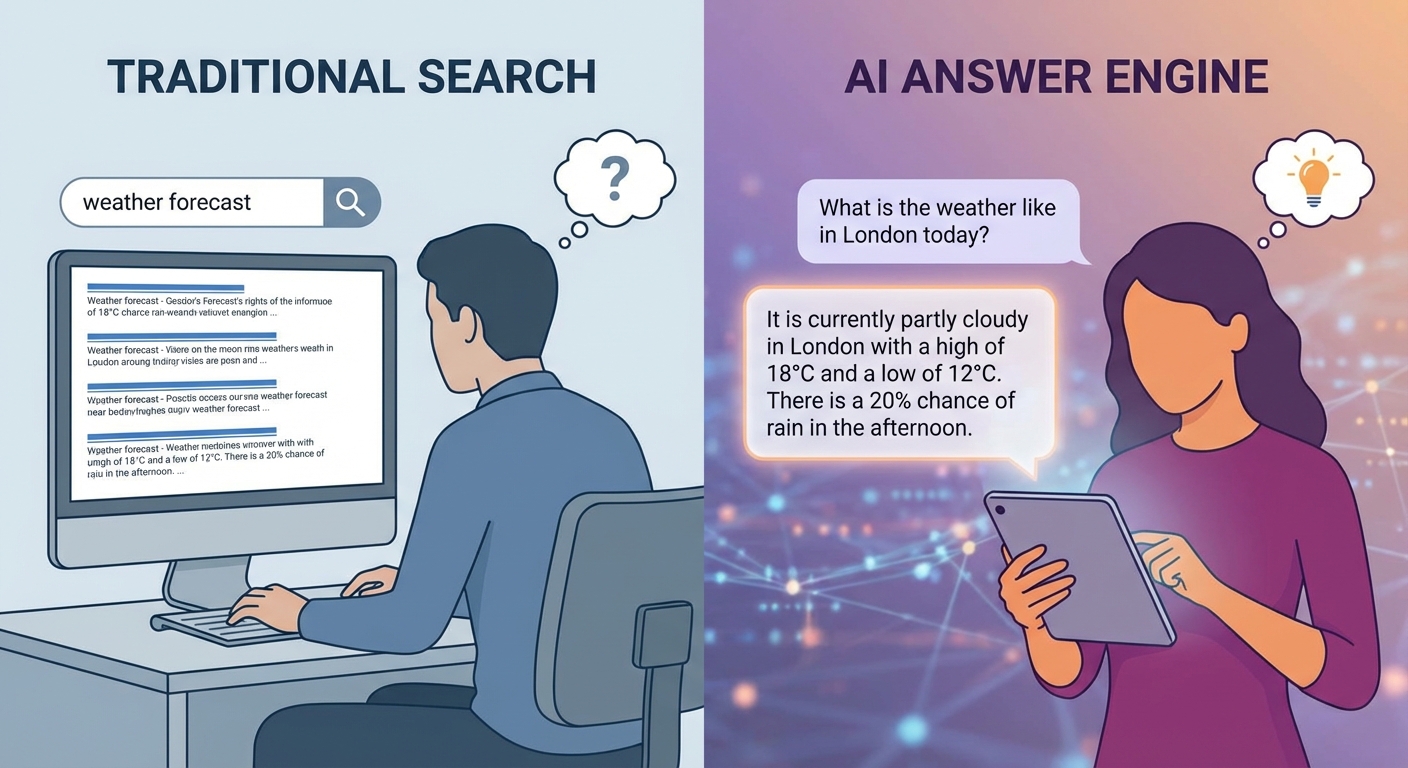
The traditional way we think about the internet--typing keywords into a box and scrolling through blue links--is evaporating.
People aren't "Googling" anymore; they are "Asking AI."
Whether it's ChatGPT, Claude, or Perplexity, the way information is discovered has fundamentally changed.
If your business isn't showing up in those AI-generated answers, you're effectively invisible to the next generation of customers.
But here’s the kicker: Most small businesses are still using 2010 playbooks for a 2026 world.
If you would, let me show you how to leverage specific AI tools and strategies to not just survive this shift, but to dominate it.
We’re going to look at two distinct challenges; how to optimize for AI citations and how to solve the "context rot" problem that kills most AI implementations.
⚡ The Quick Facts (TL;DR)
Here are the core findings for the busy ones:
| Entity | Problem | Solution |
|---|---|---|
| Traditional Analytics | Misses 90% of AI bot traffic | BotSight |
| Large Documents | Causes "Context Rot" in AI | CGC (Context Graph Connector) |
| AI Citations | Invisible to ChatGPT/Claude | Citation Optimization |
| Data Access | Context Limits & Hallucinations | Recursive Language Models (RLM) |
🧪 THE AGENCY PLAYBOOK: AI CITATION OPTIMIZATION
If you run a marketing agency, you've probably noticed that SEO is getting harder.
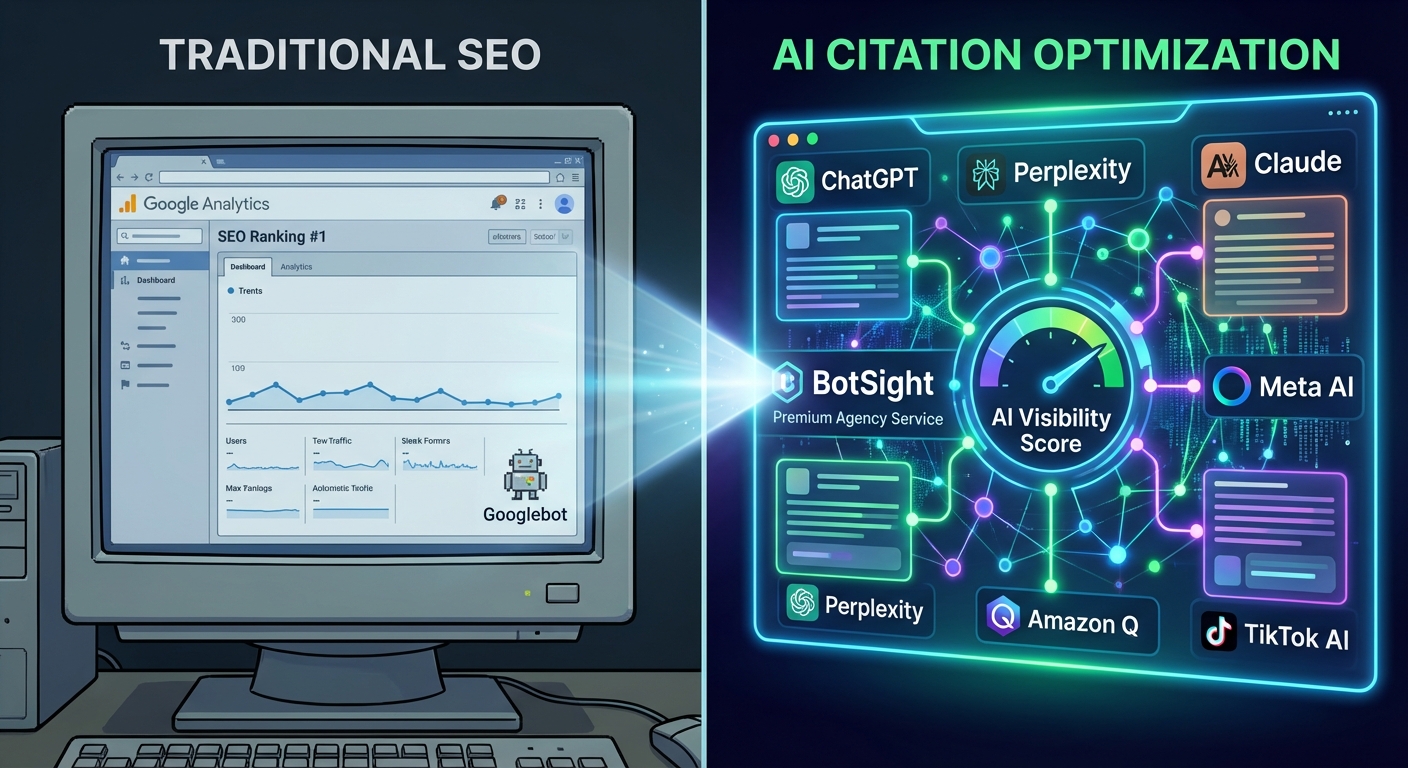
Standard Google Analytics [reports] only a fraction of the story.
Most AI bots, like the ones powering SearchGPT or Perplexity, skip JavaScript entirely for speed.
Since Google Analytics [requires] JavaScript to fire, those bots are invisible to your current tracking.
Here is the brutal truth: Search Engine Rankings and AI Citation Frequency [are] two completely different games.
You could rank #1 on Google for "best sustainable coffee" but never show up in a ChatGPT recommendation if the bot can't (or for whatever reason chooses not to) crawl your site efficiently.
BotSight [tracks] these requests before they even hit the browser.
This means you can see exactly which AI bots are crawling your client's site, which pages they care about, and how often they return.
For an agency, this is a goldmine. You can now offer AI Citation Optimization as a premium service.
AI Citation Optimization [increases] the likelihood of your client being mentioned in a ChatGPT response.
Instead of guessing, you use the Pro features of BotSight to generate white-label reports that show a client their "AI Visibility Score."
Visibility Scores [measure] how well the AI systems understand and trust your content.
It’s no longer about just ranking #1 on a search page; it’s about being the factual foundation for an AI’s answer.
📊 THE RESULTS: SEEING THE INVISIBLE
When I first installed BotSight, I was shocked at what I found.
My site was getting hit by bots from Amazon Q, TikTok AI, and Meta AI every single day.
Standard Analytics [missed] over 90% of this traffic.
| Traffic Source | Visibility in GA | Visibility in BotSight |
|---|---|---|
| Googlebot / Bingbot | High (~100%) | High (~100%) |
| GPTBot (ChatGPT) | Near Zero | High (~100%) |
| Claude-Web | Near Zero | High (~100%) |
| Perplexity Bot | Near Zero | High (~100%) |
The Insight: If you don't know who is reading your site, you can't optimize for them.
BotSight [gives] you the map you need to navigate the AI-first web.
🧠 THE END OF CONTEXT ROT: TRULY INFINITE REASONING
Now, let's talk about the data inside your business.
Every business owner wants to "chat with their data," but the reality is often disappointing.
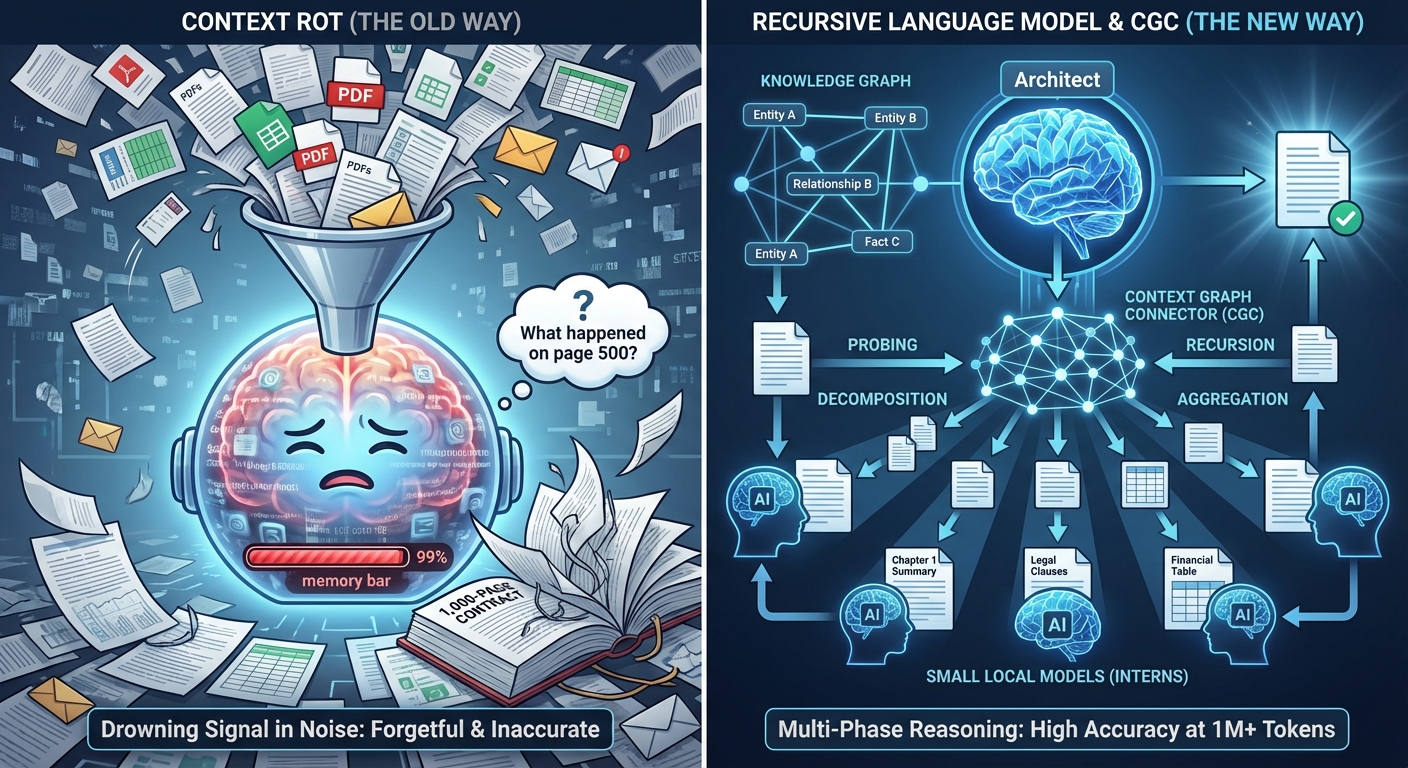
The problem is what researchers call "Context Rot."
Context Rot [degrades] the reasoning ability of even the best models like Gemini 3 or GPT-5.2.
As you add more data to a single prompt, the attention mechanism in most LLMs [drowns] the signal in noise.
Think of it like trying to read a 1,000-page contract all in one go.
You can see the page in front of you, but you've forgotten what happened 500 pages ago.
This is where the Recursive Language Model (RLM) strategy changes everything.
Instead of forcing an AI to "swallow" a 500-page manual, the Context Graph Connector (CGC) [enables] a multi-phase reasoning process.
The Architect & The Interns
The RLM strategy follows four distinct phases:
- Probing: The model [inspects] the data structure without reading it all. It asks, "What kind of data is this?" and "Where are the key entities?"
- Decomposition: The model [breaks] the problem into smaller, logical chunks. Instead of "Summarize this library," it says "Summarize this chapter."
- Recursion: Small Local Models [analyze] each chunk in isolation. This prevents "context pollution" because each intern only sees their specific task.
- Aggregation: The "Architect" [synthesizes] the final answer from those clean, processed findings.
Recursive Reasoning [outperforms] standard long-context windows by a massive margin.
In recent MIT benchmarks, this approach [maintained] 58% accuracy at 1 million tokens, while standard frontier models [hit] near-zero accuracy at just 33k tokens on complex reasoning tasks.
CGC [brings] this high-end research directly to your desktop.
With CGC, your AI [navigates] your data like a human analyst would, querying only the nodes it needs.
🛠️ THE PLAYBOOK: BUILDING YOUR AI DATA INFRASTRUCTURE
If you're a small business owner, you don't need a million-dollar budget to do this. You just need the right infrastructure.
Step 1: Audit Your AI Visibility
Start by downloading BotSight. See which bots are actually looking at your product pages. If you see ChatGPT is visiting your FAQ page every day but never hitting your technical specs, that's a signal. BotSight [identifies] the content gaps that prevent you from being cited.
Step 2: Stop Pasting, Start Connecting
Stop uploading sensitive PDFs to random web portals. CGC [connects] your databases and files directly to your AI assistant. Because it uses local extraction, your data [stays] on your machine. Persistent Knowledge Graphs [remember] facts across sessions, so you don't have to retrain your agent every morning.
Step 3: Industry-Specific Intelligence
A legal document [requires] different nodes than a financial spreadsheet. That's why the Pro version of CGC [includes] 11 industry-specific extraction packs.
- Legal Pack: [Exposes] clauses, liability terms, and jurisdiction relationships.
- Finance Pack: [Extracts] balance sheet triples and tax logic from spreadsheets.
- Tech Pack: [Maps] documentation, code dependencies, and API structures.
By using these specialized patterns, your Recursive Language Model [builds] a graph that actually makes sense for your specific business.
� PRO TIP: USE SMALL MODELS FOR EXTRACTION
You don't need GPT-5 to find a date in a document. Small models (like 3B or 7B parameters) [perform] extraction tasks faster and cheaper. CGC [leverages] these local models to handle the "grunt work," saving the big brains for the high-level reasoning. This [reduces] your API costs by up to 80% while increasing your data processing speed.
🔒 SECURITY AND PRIVACY: THE LOCAL ADVANTAGE
Here is what drives me crazy: companies sending their entire client database to the cloud just to "summarize" a meeting. In a world governed by GDPR and CCPA, your data is your liability. Running extraction locally with CGC [mitigates] this risk. Your primary LLM only sees the extracted facts, not the raw, sensitive data. Local Knowledge Extraction [protects] your intellectual property while giving you the benefits of cloud-scale intelligence.
⚠️ WATCH OUT FOR: THE HALUCINATION TRAP
Many businesses use Retrieval-Augmented Generation (RAG) but still get hallucinations. This usually happens because the "chunks" of data sent to the AI are missing context. If the AI reads "The price is $50" but doesn't know which product that price belongs to, it will guess. Knowledge Graphs [solve] this by linking those chunks together. Without the links, your AI is just guessing based on snippets. CGC [builds] the bridges between your data points so the AI never has to guess.
THE FUTURE IS AGENTIC
We are moving from "AI as a toy" to "AI as an employee."
An employee needs a memory, a map, and a clear view of the market.
BotSight [is] the map. CGC [is] the memory.
The businesses that implement these tools today will be the ones cited as the "authorities" tomorrow.
Don't let your business be a footnote in the digital archives.
Take control of your AI destiny today.
The future belongs to the operators who know how to feed the machine the right data.
This is your moment to lead the AI revolution in your industry.
CHEERS!