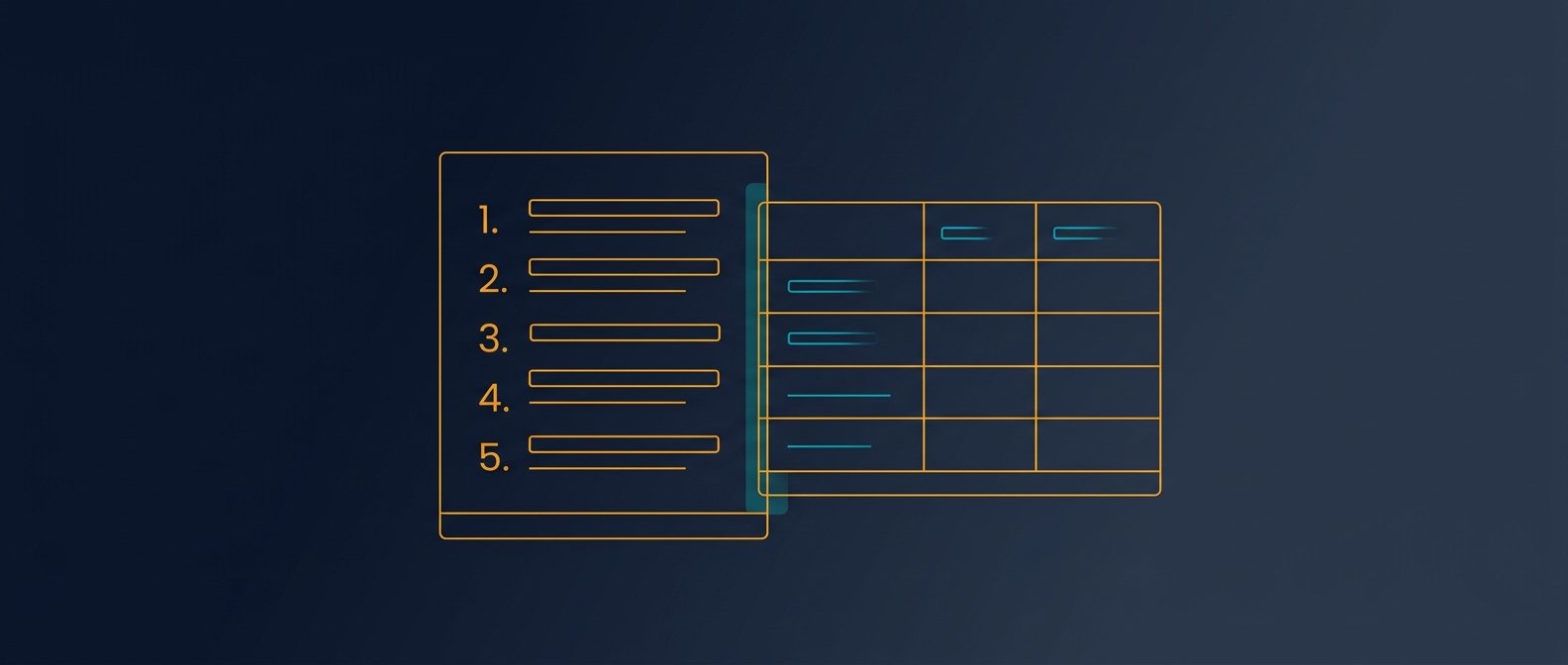
Listicles and comparison pages are not just popular content formats. They are the two structural templates most likely to be cited by AI search engines, because they present information in the exact discrete, labeled units that AI extraction pipelines prefer.
Here is the data point that should change how you plan content: pages cited by AI platforms contain a median of 13.75 list sections, roughly 17 times more than typical uncited pages (Sellm, 2024). Comparison tables are the single highest-extraction format across ChatGPT, Perplexity, Claude, and Gemini. And "Best for [Use Case]" framing, a hallmark of well-built listicles, directly matches the 31.2% of autocomplete queries of all queries classified as discovery intent (Lee, 2026).
These two formats dominate AI citations for a mechanical reason: AI models are extraction engines, not readers. They parse pages looking for discrete, labeled, self-contained information units they can pull into a synthesized response. Listicles and comparison tables deliver exactly that structure. Long narrative prose does not.
This guide covers why these formats work, provides templates for both, explains which schema to pair with each, and flags the common mistakes that kill citation odds. All findings are grounded in peer-reviewed and preprint research across 19,556 queries and 4,658 crawled pages.
📊 WHY LISTICLES AND COMPARISONS WIN: THE EXTRACTION ADVANTAGE
AI platforms do not "read" your content the way a human does. They parse it, identify structural units, extract discrete facts, and synthesize a response. Citations go to sources that provided the cleanest extractable units.
This creates a structural bias toward two content formats:
| Format | Why AI Prefers It | Key Data Point |
|---|---|---|
| Listicles (data-rich) | Each list entry is a self-contained, citable unit | 13.75 list sections median on cited pages (Sellm, 2024) |
| Comparison tables | Feature-by-feature grids map directly to comparison queries | Highest extraction rate of any format (Lee, 2026) |
Both formats share a critical property: information is pre-segmented. The AI model does not need to parse three paragraphs of narrative to find the answer. It can extract a table cell, a list entry, or a "Best for" recommendation directly.
Aggarwal et al. (2024) demonstrated that targeted content optimization strategies can boost visibility in generative engine responses by up to 40%, with format and structure being core drivers of that improvement (Aggarwal et al., 2024). Note: this Princeton lab result has not replicated on production AI platforms in our testing; see our replication analysis.. Listicles and comparison tables are the structural embodiments of that principle.
The Bottom Line: If your content presents information as continuous prose, AI models must work harder to extract citable units, and they will often skip your page in favor of one that pre-segments the same information. Format is the extraction interface.
📋 COMPARISON PAGES: THE HIGHEST-EXTRACTION FORMAT
Comparison pages are the single most AI-friendly content format. When a user asks "best CRM for small business" or "Notion vs Airtable for project management," the AI model needs to compare multiple options across multiple dimensions. A well-structured comparison table provides exactly the data structure the model needs.
The query intent match
Discovery queries account for 31.2% of autocomplete queries of all queries in the Lee (2026) dataset. These queries follow a predictable pattern: users evaluating options, comparing products, or looking for the "best" solution for a specific use case. Comparison pages are the natural structural match for this intent type because the page format mirrors the comparison structure the AI model needs to produce.
Comparison queries (2.3%) are even more direct: "X vs Y" queries where the user explicitly wants a side-by-side evaluation. For these, a comparison table is the only format that can be extracted without significant reinterpretation.
What makes a comparison table AI-extractable
Not all tables are equally useful. The difference between a table that gets cited and one that gets ignored comes down to specificity and self-containment.
| Table Quality | Example Cell | AI Extractability |
|---|---|---|
| Vague labels | "Good," "Fair," "Poor" | Low: no concrete data to cite |
| Specific values | "$49/mo," "14-day trial," "99.9% uptime" | High: discrete facts the model can attribute |
| Missing context | Raw numbers with no units | Low: ambiguous without interpretation |
| Self-contained cells | Each cell answers a question independently | High: extractable without reading the full table |
Comparison page template
| Section | What to Include | Why It Matters |
|---|---|---|
| 1.Summary comparison table | All options across 5-8 key dimensions in semantic HTML | Highest extraction format; AI crawlers parse HTML tables directly |
| 3. "Best for [Use Case]" per option | Explicit recommendation tied to specific use case | Matches 31.2% of autocomplete queries discovery intent queries |
| 4. Individual deep dives | One section per option with pros/cons, pricing, use-case fit | Self-contained sections enable independent extraction |
| 5. FAQ section with schema | 3-5 questions from Google Autocomplete, PAA, Reddit | FAQPage schema (OR = 1.39) captures informational intent |
For a broader look at all content formats ranked by extraction rate, see our content formats guide.
The Bottom Line: Comparison tables are the format that most directly maps to how AI models build multi-option responses. If you compare anything, put it in a table with specific values in every cell.
📝 LISTICLES: THE HIGH-CITATION FORMAT MOST PEOPLE BUILD WRONG
The Sellm 400K-page study found that AI-cited pages contain a median of 13.75 list sections, roughly 17 times more than typical web pages. But this does not mean any listicle gets cited. The difference between a high-citation listicle and a low-citation one is entirely about data density per entry.
Why data-rich listicles work
A listicle that says "10 Best CRMs for 2026" with one vague paragraph per entry is not a citation magnet. A listicle that includes pricing, feature comparisons, use-case recommendations, and honest limitations for each entry is. The reason: each entry in a data-rich listicle functions as a self-contained answer to a potential query.
When a user asks Perplexity "best CRM for solo founders," the model can extract your entry for the top-ranked solo-founder CRM, complete with pricing, key features, and a "Best for" recommendation. Each list entry is an independent citable unit.
The data-rich listicle template
For each entry in your listicle, include these elements:
| Element | Purpose | Example |
|---|---|---|
| Specific pricing | Enables cost comparison queries | "$29/mo starter, $79/mo pro, custom enterprise" |
| Quantified features | Provides extractable specs | "Up to 10,000 contacts, 5 pipelines, 50GB storage" |
| "Best for" framing | Matches discovery intent (31.2% of autocomplete queries) | "Best for: agencies managing 10+ client accounts" |
| Pros/cons per entry | Gives evaluation signals | "Pro: unlimited users. Con: no mobile app yet." |
| Star or numerical rating | Quick comparative signal | "4.7/5 based on 2,300 reviews" |
Structure each entry as: "Best for" statement first, then a two-sentence overview, then key specs as a bulleted list, then pros/cons. Each entry built this way becomes a self-contained, extractable unit. The AI model does not need to read the full listicle to cite your recommendation for a specific use case.
The Bottom Line: Lists are not inherently better than narrative. Lists with embedded data are. Each list entry should function as a standalone, citable answer to a potential query.
🏷️ SCHEMA PAIRING: WHAT TO USE WITH EACH FORMAT
Schema markup selection is a high-leverage decision for both listicles and comparison pages. The wrong schema type can actively suppress citation odds.
Lee (2026) found dramatic variation in AI citation probability by schema type, and the findings have direct implications for format-schema pairing:
| Schema Type | Odds Ratio | Best Paired With | Why |
|---|---|---|---|
| Product | 3.09 (p < 0.001) | Comparison pages | AI models extract structured product attributes for discovery queries |
| Review | 2.24 (p < 0.001) | Review listicles, roundup posts | Structured sentiment data maps to review-seeking queries |
| FAQPage | 1.39 (p < 0.05) | FAQ sections in both formats | Pre-structured Q&A units match the chatbot interaction model |
| Article | 0.76 (p < 0.05) | Avoid on structured content | Signals editorial/opinion content; negative association with citation |
For comparison pages: use Product schema
Product schema (OR = 3.09) is the strongest positive predictor of AI citation. On comparison pages, implement Product schema for each item being compared. Include name, description, brand, offers (with price, priceCurrency, availability), and aggregateRating where available.
The combination of a comparison table (highest extraction format) with Product schema (strongest schema signal) creates the strongest possible structural foundation for AI citation.
For listicles: use a combination approach
Data-rich listicles benefit from a layered schema approach:
- Product or Review schema on each list entry (depending on whether you are listing products or reviewing them)
- FAQPage schema on the FAQ section at the bottom of the page
- Avoid Article schema as the primary page-level markup, even though listicles feel "editorial." The data says Article schema hurts citation odds on pages with structured data.
Schema completeness matters more than schema count
What matters is attribute completeness within each schema instance. A Product schema with name, price, brand, aggregateRating, offers, and sku is far more useful than one with only name and description (Lee, 2026).
For a complete schema implementation guide with JSON-LD examples, see our schema markup for AI citations guide.
The Bottom Line: Product schema on comparison pages. Review or Product schema on listicle entries. FAQPage schema on the FAQ section. Never Article schema on pages with structured data.
🎯 INTENT MATCHING: THE FILTER BEFORE FORMAT
Format matters, but intent matching matters more. Lee (2026) found that query intent is the strongest aggregate predictor of which content gets cited. Format and schema are second-level selectors that determine the winner within an intent-matched pool.
Here is how the query intent distribution maps to listicles and comparisons:
| Intent Type | Query Share | Best Format Match | Example Query |
|---|---|---|---|
| Informational | Informational (61.3% of real-world autocomplete queries, though our citation experiments used a balanced 20% per intent design) | FAQ sections within listicles | "How does CRM pricing work?" |
| Discovery | 31.2% of autocomplete queries | Comparison tables, "Best for" listicles | "Best CRM for small business" |
| Validation | 3.2% | Pros/cons within listicle entries | "Is HubSpot worth it?" |
| Comparison | 2.3% | Side-by-side comparison tables | "Salesforce vs HubSpot" |
| Review-seeking | 2.0% | Review-style listicles with ratings | "Notion reviews from real users" |
The strategic play: build your listicle or comparison page targeting discovery intent (31.2% of autocomplete queries), then add an FAQ section targeting informational intent (61.3% of autocomplete queries). This covers 92.5% of the query space with a single page.
For a full breakdown of how intent drives citation across platforms, see our generative engine optimization guide.
The Bottom Line: Format without intent matching is wasted effort. Your listicle or comparison page must be built around the specific query intent pool you want to win, not just the format you want to use.
🏆 REVIEW AGGREGATORS: WHY THEY DOMINATE (AND HOW TO COMPETE)
Review aggregators (G2, Capterra, TrustRadius) earn 16 to 21% of discovery citations across AI platforms (Lee, 2026). They win because they combine massive structured data density, Product and Review schema at scale, and natural "Best for" segmentation by use case and company size.
You cannot outcompete them on review volume. But you can win on specificity. A review aggregator covers "Best CRM Software" generically. Your comparison page can target "Best CRM for Real Estate Teams Under 20 People" with far more specific recommendations and use-case fit analysis. AI models need specific answers for specific queries, and your focused comparison can outperform a generic aggregator for niche discovery queries.
For a deeper look at how to write content AI platforms actually cite, see our writing guide.
The Bottom Line: Review aggregators win on volume. You win on specificity and freshness. Target the niche queries that aggregators cannot adequately cover.
🚫 COMMON MISTAKES THAT KILL LISTICLE AND COMPARISON CITATIONS
Even well-structured listicles and comparison pages can fail to earn AI citations. The most damaging mistake is excessive outbound affiliate links with weak internal linking. Lee (2026) found that pages dominated by external links with low internal link counts have an OR of 0.47, meaning roughly half the citation probability of pages with balanced link ratios. Maintain at least two to three internal links for every outbound link.
| Mistake | Impact | Fix |
|---|---|---|
| Heavy external + low internal links | OR = 0.47 (half citation odds) | 2-3 internal links per external link |
| Vague table values ("Good," "Fair") | Low extraction rate | Specific numbers in every cell |
| No "Best for" framing | Misses 31.2% of autocomplete queries discovery intent | Add explicit use-case recommendations |
| No FAQ section | Misses 61.3% of autocomplete queries informational intent | Add 3-5 real questions with FAQPage schema |
| Article schema on structured pages | OR = 0.76 (negative) | Use Product or Review schema |
| Key findings buried late | ||
| The Bottom Line: Most listicle and comparison failures are structural, not content quality issues. A mediocre comparison with correct structure will outperform an excellent comparison with poor structure in AI citation rates. |
📐 THE COMPLETE IMPLEMENTATION CHECKLIST
Before publishing any listicle or comparison page targeting AI citation, verify these elements:
| Checkpoint | Applies To | Priority |
|---|---|---|
| Opening verdict or top recommendation in first 100 words | Both formats | Critical |
| Summary comparison table with specific values in every cell | Comparison pages | Critical |
| "Best for [Use Case]" framing on every item or entry | Both formats | Critical |
| Product schema with high attribute completeness | Comparison pages | Critical |
| FAQ section with 3-5 real questions and FAQPage schema | Both formats | High |
| Semantic HTML tables (not CSS grids or images) | Comparison pages | High |
| Pros/cons with quantified, specific trade-offs | Both formats | High |
| Review or Product schema on each listicle entry | Listicles | High |
| Internal-to-external link ratio at least 2:1 | Both formats | High |
| Each list entry is self-contained and data-rich | Listicles | High |
| 2,500+ words with clean content-to-HTML ratio | Both formats | Medium |
| No Article schema as primary page markup | Both formats | Medium |
| Star or numerical rating per entry | Listicles | Medium |
For a full site-wide content audit, try our free AI visibility check. For strategic content planning support, see our content strategy service.
❓ FREQUENTLY ASKED QUESTIONS
Should I choose a listicle format or a comparison format for my content?
It depends on query intent. If users search "best [product] for [use case]," a data-rich listicle with "Best for" framing is the natural fit. If users search "[Product A] vs [Product B]," a side-by-side comparison table is correct. Many high-performing pages combine both: a listicle structure with comparison tables embedded within. Use Google Autocomplete and People Also Ask to identify whether your audience searches in listicle or comparison patterns.
How many items should a listicle include for AI citation optimization?
The data suggests 5 to 15 items is most effective. Fewer than 5 limits your ability to serve diverse discovery queries. More than 15 dilutes per-entry data density. The critical factor is not the count but data richness per item. A 7-item listicle with pricing, specs, pros/cons, and "Best for" framing per entry will outperform a 25-item listicle with one vague paragraph per entry.
Can I use the same page to target both listicle and comparison keywords?
Yes, and this is the ideal structure for many topics. Build the page as a listicle with a summary comparison table near the top. This gives the AI model two extraction paths: the table for comparison queries and individual entries for discovery queries. Add an FAQ section for informational intent, and you cover 92.5% of the query space. Place the comparison table within the first 30% of the page.
Does adding comparison tables to an existing page improve AI citation odds?
Only if the tables contain specific, extractable data. Real prices, feature counts, and measurable specifications outperform vague qualitative labels. Use semantic HTML markup (<table>, <thead>, <th>, <td>) rather than CSS layouts, because AI crawlers parse HTML tables directly and clean table markup improves content-to-HTML ratio, itself a citation predictor (Lee, 2026).
What is the biggest mistake people make with listicle content for AI search?
Building listicles with low data density per entry. AI already knows generic information from its training data. It cites pages that provide specific, structured facts it cannot generate from memory: exact pricing tiers, quantified feature limits, specific use-case fit, and honest limitations. The second most common mistake is excessive outbound affiliate links without strong internal linking, which drops citation probability to roughly half (OR = 0.47).
📚 REFERENCES
Lee, A. (2026). "Query Intent, Not Google Rank: What Best Predicts AI Citation Behavior." AI+Automation Research. DOI: 10.5281/zenodo.18653093
Aggarwal, P., Murahari, V., Rajpurohit, T., Kalyan, A., Narasimhan, K., & Deshpande, A. (2024). "GEO: Generative Engine Optimization." Proceedings of the 30th ACM SIGKDD Conference on Knowledge Discovery and Data Mining. DOI: 10.48550/arXiv.2311.09735
Sellm, J. (2024). "Large-Scale Analysis of AI-Cited Web Content: Structural Features of 400K Pages." Preprint.