
AI SEO EXPERIMENTS
Perplexity Lazy Gap: AI Citations Cite Content 3x Fresher Than Google
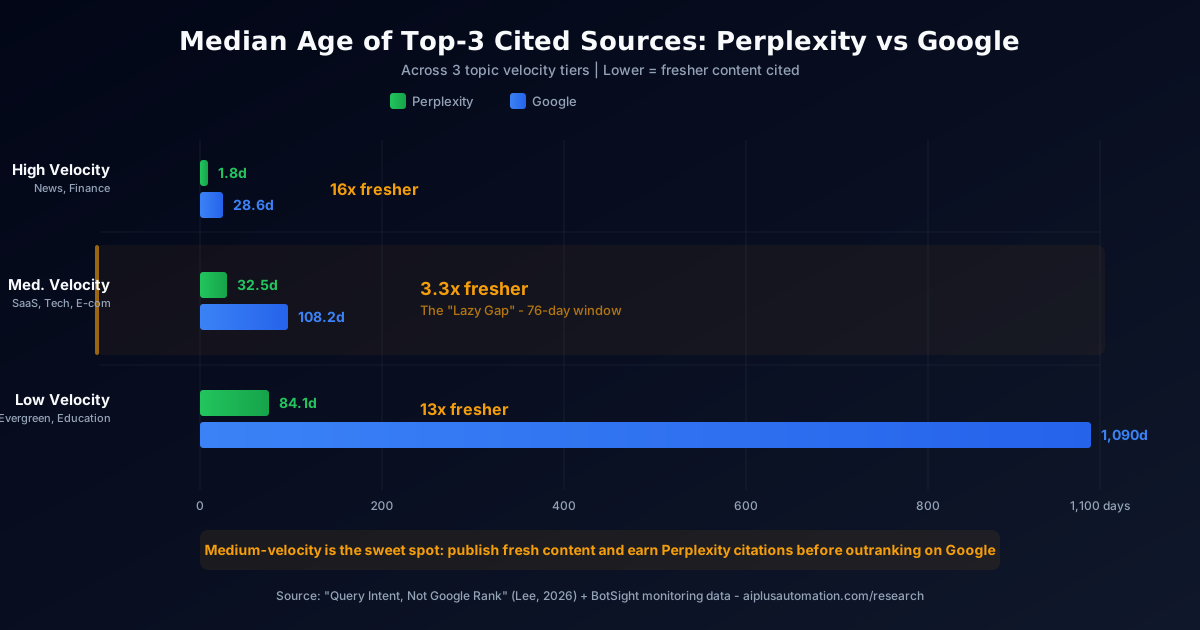
Perplexity has a strong bias toward recent content. How strong? I measured it.
I compared the age of top-3 cited sources across Perplexity and Google for queries at three different "topic velocities" - how fast the subject matter changes. The freshness gap between the two is large enough to be strategically useful.
The data
I pulled top-3 citations from both Perplexity (via API) and Google (via Custom Search API) across queries spanning three velocity tiers: high (news, finance, sports scores), medium (SaaS reviews, tech comparisons, e-commerce), and low (history, education, evergreen reference).
Median age of top-3 cited sources:
| Topic Velocity | Perplexity | Perplexity's Freshness Advantage | |
|---|---|---|---|
| High (news, finance) | 1.8 days | 28.6 days | 16x fresher |
| Medium (SaaS, tech, e-commerce) | 32.5 days | 108.2 days | 3.3x fresher |
| Low (evergreen, education) | 84.1 days | 1,089.7 days | 13x fresher |
The medium-velocity tier is the most interesting. Google's top results for SaaS comparisons, product reviews, and tech guides average over 3 months old. Perplexity's average about 1 month. That 76-day gap is what I'm calling the "Lazy Gap."
Why the medium-velocity gap matters most
For high-velocity topics (breaking news), both platforms try to be fresh - Perplexity is just faster. For low-velocity topics (what year did X happen), freshness barely matters - the correct answer doesn't change. Neither of these creates much strategic opportunity.
Medium-velocity topics are different. These are queries where the "best" answer changes every few months - "best project management tool 2026," "CRM comparison," "how to deploy on AWS" - but not so fast that daily updates are necessary.
In this tier, Google's ranking algorithm rewards established authority. A comprehensive comparison guide published 6 months ago with strong backlinks will hold its Google position for a long time, even as the information gets stale. The author may not update it for another 6 months because it's still ranking fine.
Perplexity doesn't work that way. Its index biases heavily toward recency. That 6-month-old comparison guide that still ranks #1 on Google is competing against content published last month on Perplexity - and losing.
This creates a window: you can publish updated content that earns Perplexity citations before it would ever outrank the established authority pages on Google.
How Perplexity's freshness bias works
Perplexity maintains a pre-built index via PerplexityBot (with 49.6% Google domain overlap, the highest of any AI platform) via PerplexityBot, a background crawler separate from the consumer product. It doesn't fetch pages during conversations - everything is served from this pre-built index.
The freshness bias appears to operate through several mechanisms:
Explicit date signals matter. Perplexity's date extraction depends on parseable publication metadata. Pages with datePublished and dateModified in schema markup, plus visible on-page date stamps, perform better than undated content. In our testing, pages without parseable dates were effectively treated as undated - and undated content performs poorly in a freshness-biased system.
Content decay is real. Based on patterns in our data, content visibility on Perplexity starts to decay within 2-3 days of publication for high-velocity topics. For medium-velocity content, the decay is slower but still measurable - a competitor's newer article will beat your older article, even if your domain authority is higher.
Recrawl frequency varies by content type. From our BotSight monitoring data, we found that FAQ pages get roughly 2x more recrawls (observed in our server-side monitoring, not a controlled experiment) from AI bots than blog posts. Pages that are frequently updated (and signal those updates through dateModified) tend to be recrawled more often.
Exploiting the Lazy Gap
The medium-velocity Lazy Gap is the most actionable finding from our freshness research. Here's how to use it:
1. Identify stale authority content in your vertical. Search Google for medium-velocity queries in your space. Look at the publication dates of the top 3-5 results. If they're 3+ months old, there's a Lazy Gap opportunity.
2. Publish comprehensive, dated content. Write something better and more current than the stale authority pages. Include explicit datePublished and dateModified schema markup. Put a visible "Last updated" date near the top of the page.
3. Make sure PerplexityBot can access it. Check your robots.txt - PerplexityBot should be allowed. Keep your sitemap updated with accurate <lastmod> tags. PerplexityBot respects robots.txt and uses sitemaps for discovery.
4. Refresh on a 60-90 day cycle. The Lazy Gap data suggests that refreshing medium-velocity content every 2-3 months keeps you within Perplexity's freshness window while the stale authority pages on Google continue to age.
5. Don't fake freshness. Changing the displayed date without actually updating content is detectable and counterproductive. The update needs to be substantive - new data, updated comparisons, revised recommendations.
This doesn't replace Google SEO
I want to be clear: this is not a "forget Google, just optimize for Perplexity" argument. Google still drives the majority of search traffic. The Lazy Gap is an additional channel, not a replacement.
But for specific use cases, it's powerful:
- New sites with no domain authority. You can't outrank established competitors on Google for months. On Perplexity, fresh comprehensive content can earn citations within days.
- Content in fast-moving spaces. If your competitors' Google-ranking content is genuinely outdated, Perplexity will actively prefer your newer version.
- Product launches and updates. When you ship something new, Perplexity will surface your fresh announcement before Google's algorithm catches up.
The key insight is that Perplexity and Google are operating on different clocks. Google optimizes for authority accumulated over time. Perplexity optimizes for recency. The gap between those two clocks is the Lazy Gap, and it's widest for medium-velocity topics.
The broader platform picture
Perplexity isn't the only platform with a freshness bias, but it's the most extreme:
- Google AI Mode is built on Google Search, so it inherits Google's freshness logic - which means established authority pages persist longer.
- ChatGPT live-fetches pages during conversations, so it can access fresh content in real time. But its URL discovery still goes through Bing's index, which has its own crawl/index lag.
- Claude is demand-driven - it only fetches when its training data is insufficient. For well-covered topics, it may never fetch your fresh content because it already has "good enough" information from training.
Perplexity's architecture - pre-built index, aggressive recrawling, strong freshness signal in ranking - makes it the platform where a deliberate freshness strategy has the highest ROI.
Implementing freshness signals: the exact markup
If you want Perplexity (and other freshness-biased systems) to detect your dates, here is what to deploy. Visible date stamps alone are not enough. AI parsers prefer machine-readable signals, with the visible version as a fallback.
Article schema with both dates:
<script type="application/ld+json">
{
  "@context": "https://schema.org",
  "@type": "Article",
  "headline": "Your Title",
  "datePublished": "2026-01-15T08:00:00-05:00",
  "dateModified": "2026-04-22T14:30:00-04:00",
  "author": {
    "@type": "Person",
    "name": "Your Name"
  }
}
</script>
Open Graph article tags:
<meta property="article:published_time" content="2026-01-15T08:00:00-05:00">
<meta property="article:modified_time" content="2026-04-22T14:30:00-04:00">
Visible on-page indicators:
<time datetime="2026-04-22">Last updated April 22, 2026</time>
Sitemap.xml lastmod:
<url>
  <loc>https://example.com/your-page</loc>
  <lastmod>2026-04-22</lastmod>
</url>
The same dateModified value should appear in all four places. AI parsers cross-check. If your schema says you updated last week but your sitemap says six months ago, parsers default to the older signal.
Freshness is half the equation. Depth is the other half.
The Lazy Gap is real, but it is not a license to publish thin content as long as it is dated this week. Our larger study (The SEO Floor) shows that pages cited repeatedly across AI platforms (the high-repeat-cited cohort) are not just fresh, they are also longer and denser:
| Feature | One-hit cited pages | High-repeat cited pages | Difference |
|---|---|---|---|
| Word count (median) | 2,516 | 3,211 | +28% |
| Statistics per 1k words | 9.63 | 12.30 | +28% |
| Primary-source score | -4.72 | +0.36 | +5.08 |
| Schema types per page | 1.03 | 1.19 | +0.16 |
A fresh thin post earns one citation, then never gets cited again because the next freshness wave overwrites it. A fresh thick post becomes a stable answer source the model returns to. The Lazy Gap is a way to break in. Depth is what keeps you there.
For medium-velocity topics specifically, the playbook is freshness plus depth: 2,500-3,500 words, 10-15 statistics per 1,000 words, multiple schema types, refreshed every 60-90 days. That combination is what the data points to as the high-leverage zone for repeat citation.
Limitations
- Freshness measurements were taken at a point in time (early 2026). Perplexity's algorithm is a black box and could change.
- "Topic velocity" is a rough categorization. Some queries within a tier may behave differently than the median.
- We measured median ages of top-3 citations. Individual queries will vary.
- The Lazy Gap is an observation about current behavior, not a guaranteed exploit. As more content creators catch on, the window may narrow.
- I run a business that helps people optimize for AI platforms. That's my bias. The data is real, but factor in the incentive.
References
- Freshness data from: "Query Intent and Google Rank as Joint Predictors of AI Citation: A Multi-Platform Observational Study" (Lee, 2026). DOI: 10.5281/zenodo.18653093
- Perplexity crawl behavior observed via BotSight server-side monitoring
- Content decay patterns from third-party sources: Nick Lafferty, StubGroup GEO Guide