AI Strategy
The Goldilocks Zone: Balancing AI Temperature
2026-02-13
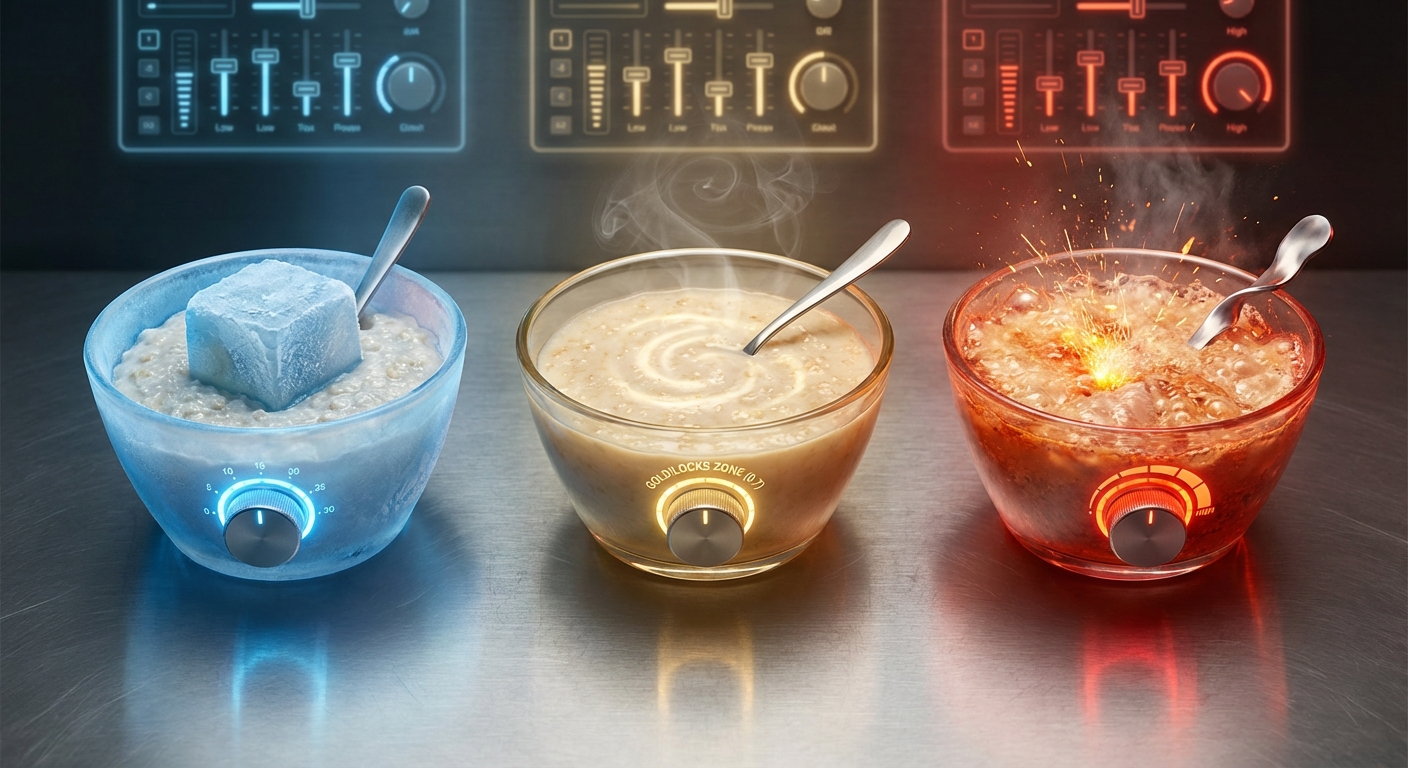
🥣 THE PROBLEM: WHY IS MY AI ACTING WEIRD?
You've probably experienced it.
Sometimes, you ask an AI to write a story, and it gives you the most generic, robotic cliché imaginable. It's boring. It's "cold."
Other times, you ask it for facts, and it starts inventing historical events that never happened. It's hallucinating. It's "hot."
The Secret: These aren't random glitches. There are hidden dials behind the chat box that control exactly how "creative" (or chaotic) the AI gets. And in many tools, you can control them.
Here is the plain-English guide to finding your Goldilocks Zone - not too hot, not too cold.
🌡️ TEMPERATURE: THE "CHAOS" SLIDER
What it is: A setting (usually between 0.0 and 2.0) that controls how "risky" the AI gets when choosing its next word.
The Analogy: The Chef
Low Temperature (0.1 - 0.3): THE STRICT BAKER Imagine a baker who follows the recipe down to the gram. If the recipe says "1 cup of sugar," they add exactly 1 cup. Every single time.
- Result: Perfect consistency. Accurate facts. But zero surprises. If you ask for a "story," it will start with "Once upon a time..." every time.
- Use for: Coding, Math, Data Extraction.
High Temperature (0.8 - 1.0+): THE JAZZ COOK Imagine a chef who refuses to measure anything. "What if we put chili powder in the chocolate cake? What about... pickles?"
- Result: Wildly creative. Unique phrasing. But sometimes, the cake tastes like pickles.
- Use for: Brainstorming, Creative Writing, Poetry.
The Goldilocks Zone (0.7): This is the default for most chat bots. It follows the recipe but throws in a specific garnish or a unique twist. It's coherent, but not robotic.
🎯 TOP-K: THE "MENU" LIMIT
What it is: A hard limit on the number of word options the AI considers.
The Analogy: Ordering Dinner
When the AI is about to speak, it has a list of 50,000 possible next words. Top-K acts like a bouncer.
- Top-K = 1: "You can ONLY order the #1 most popular dish."
- The AI must pick the most statistically likely word. This makes it a robot.
- Top-K = 50: "You can pick anything from the top 50 dishes."
- Now the AI has choices. It might pick the 49th most popular word, which adds flavor.
Why use it? To stop the AI from going completely off the rails. Even a "Jazz Cook" shouldn't be allowed to put cement in the cake. Top-K ensures the options are at least edible.
⚛️ TOP-P: THE "VIBE" NET (NUCLEUS SAMPLING)
What it is: A smarter, dynamic version of Top-K. Instead of a fixed number (like 50), it says: "Keep adding options until we are 90% sure the right word is in this pile."
The Analogy: The Casting Director
- Sometimes, there is only one perfect actor for a role (The net is small).
- Sometimes, any of 20 actors could play the part (The net is wide).
Top-P (Nucleus Sampling) adjusts the size of the net based on the context.
- If the sentence is "The capital of France is...", the net shrinks to just "Paris."
- If the sentence is "The monster looked like a...", the net widens to include "blob," "dragon," "shadow," etc.
Tip: Most experts prefer tweaking Top-P over Top-K because it adapts to the sentence.
🎛️ THE CHEAT SHEET
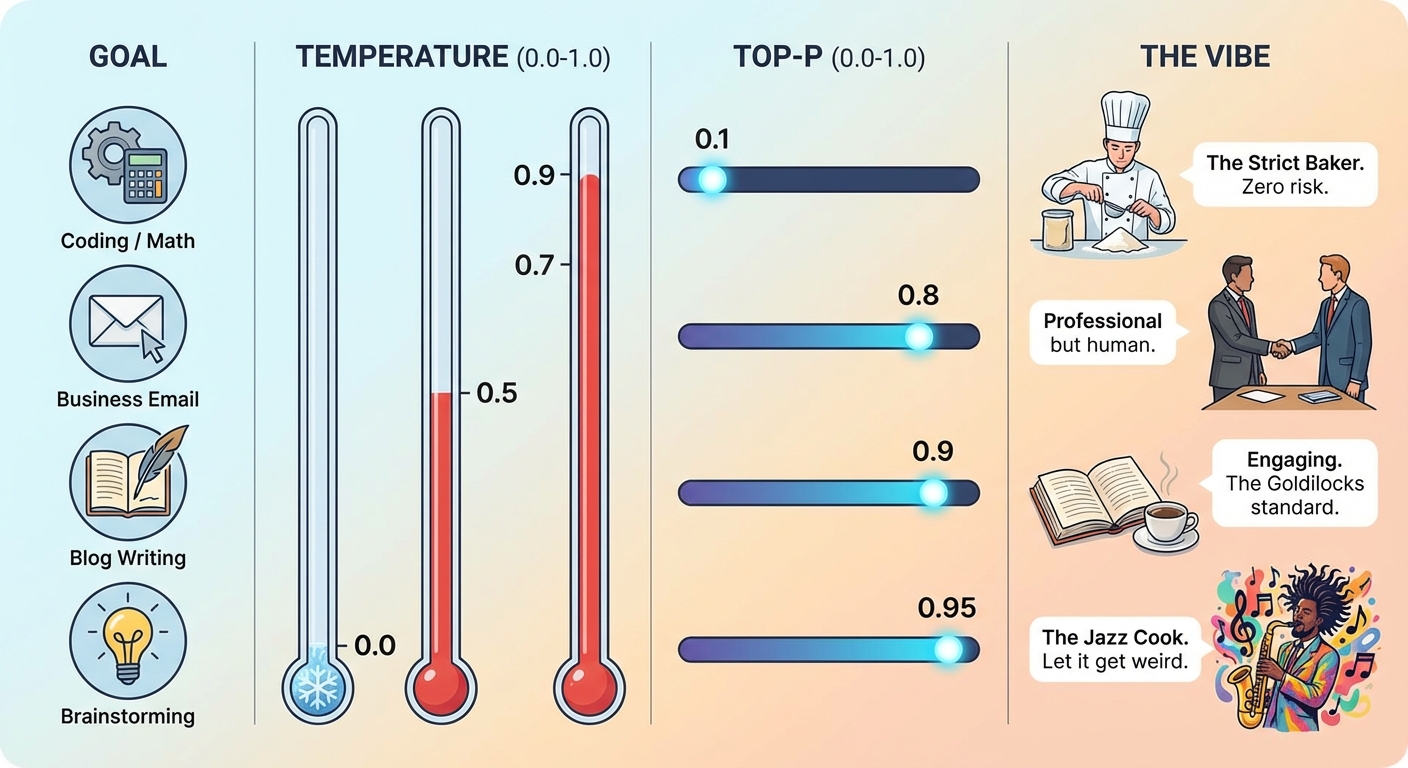
Not sure what to set? Copy these recipes.
| Goal | Temperature | Top-P | The Vibe |
|---|---|---|---|
| Coding / Math | 0.0 | 0.1 | The Strict Baker. Zero risk. |
| Business Email | 0.5 | 0.8 | Professional but human. |
| Blog Writing | 0.7 | 0.9 | Engaging. The Goldilocks standard. |
| Brainstorming | 0.9 | 0.95 | The Jazz Cook. Let it get weird. |
THE TAKEAWAY
Don't just accept the defaults. If your AI assistant feels boring, turn up the heat. If it's lying to you, cool it down.
You aren't just a user; you're the chef. Cook accordingly.